
Paul McCartney, early-to-mid 1980s:
One thing I’ll never forget at EMI was the “pop”/ “classical” switch on the right-hand-side of the console! And the control knobs were great big RAF things, that was the state of the technology then. We used to like them though, and...
 Subscribe
- Public lists
- Manton Reece - Blogroll
- Fetched
An even-better-than-usual essay by the invaluable J. B. Crawford:
[Brigadier Martin Hotine’s] greatest memorial is an artifact of his work: squat concrete pillars surmounted by a triangular brass plate. Found atop mountains and hills throughout the United Kingdom, these "tr...
Ezra Klein:
This is, I guess, the point in the column where I should call for everyone to abandon X. I have not posted regularly there in years, and I’d urge others to limit their use as well. Nor have I taken up BlueSky or Threads. I find that much time spent on any of the...
Mark Helprin to the technocrats in 1996:
The revolution that you have made is indeed wonderful, powerful, and great, and it has hardly begun. But you have not brought to it the discipline, the anticipation, or the clarity of vision that it, like any vast augmentation in the...
Indie Web Is Punk — I am putting a link to this manifesto on all my sites, trying to spread the good news: You don’t have to live on the big platforms, suffering their relentless enshittification. You have a better option.
I think Radiohead are a brilliant band, but I can’t listen to most of their music for more than two or three minutes at a time without having to turn it off because it is painful to me to listen to. Their records are engineered in ways (especially the extreme compression) that I can’t physically handle. I have been frustrated by this for decades, and keep going back to their music to see if my response has changed, but so far: Nope.
My colleagues Davide and Colleen Zori keep discovering intact Etruscan chamber tombs. Remarkable.
Jeremy Taylor (1613–1667):
It is true, [the dead in Christ] envy not, and they lie in a bosom where there can be no murmur; and they that are consigned to Kingdoms, and to the feast of the marriage-supper of the Lamb, the glorious and eternal Bridegroom of holy Souls, they ...

Mail time! — two forthcoming books. The paperback edition of The Shield of Achilles has (thanks to my learned friends Tim Larsen and Adam Roberts) a few important corrections — you should therefore buy it in preference to the hardcover, even though it’s not as beautiful. (Still pretty nice, though. Also, you could always buy both.) And I was honored to write a foreword for Bonnie’s fine book.

Fragment of wallpaper, unknown maker, about 1820, England. © Victoria and Albert Museum, London

A sample of the work of the great watchmaker George Daniels (1926-2011). I never travel to London without visiting the Clockmaker’s Museum, though I sort of miss its old rather obscure location at Guildhall.
Now that I live in central Texas, when I return to my native Alabama I am always thinking: Dang, the trees here are tall.

WSJ:
AI is trained in part on what people like, and people prefer the brown-nosing, says Myra Cheng, a computer-science Ph.D. candidate at Stanford University and lead author of a March study on agreeable AI. Participants rated sycophantic AI responses significantly higher in quality and, after interacting with a more obsequious model, said they were more likely to return to the AI.
This bodes ill.

The home of The Victorian Society was well chosen.
In 1968, [Kołakowski] was fired from Warsaw University for “forming the views of the youth in a manner contrary to the official tendency of the country,” banned from teaching and publishing entirely, and placed under constant police surveillance.
As I come to the end of my teaching career, I am bitterly disappointed in myself: I have never been formally charged with “forming the views of the youth in a manner contrary to the official tendency of the country.”
Angus taking a break from playing in the garden hose, which is his favorite thing to do that does not involve eating.

For my Buy Me a Coffee supporters I wrote a report from Mission Control.
How much would you pay for a smarter baby? — I can imagine the lawsuits later: “We paid for a smarter baby but instead we got a child who’s compassionate and generous! We’ve been screwed!”
Via Ian Leslie, a beautifully designed page on ordinary abundance.

Book/magazine cover art by Kenneth Romney Towndrow
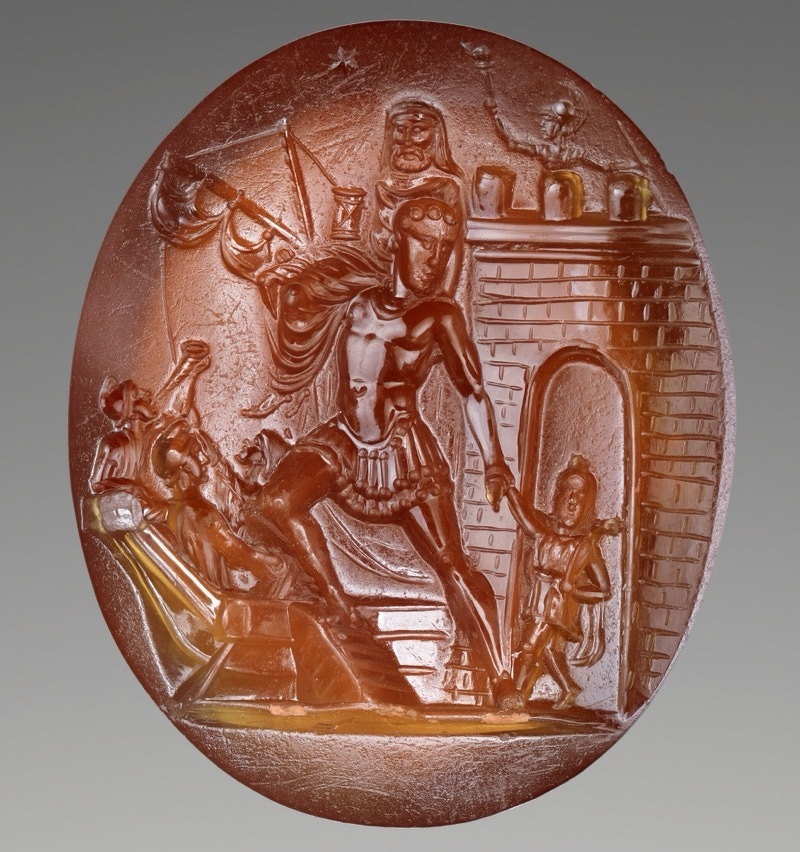
A remarkable intaglio from the Getty Museum: Aeneas and his family escaping Troy. The museum dates this around 20 B.C., which was around the time of Virgil’s death, with his poem unfinished — and surely this is a depiction of the scene specifically as described by Virgil, with Aeneas carrying Anchises on his back and leading Ascanius by the hand. Does this mean that the artist had read the in-progress Aeneid? Or that Virgil was borrowing the details from some earlier history?
The third installment of my Dispatch series on the meaning of the Second World War today.
Back in Tokyo, after the fireworks spectacular, I went to Yoyogi Park. An announcement was playing: “Rollerblading is dangerous, make sure you don’t do it! And be sure to not play catch! And stay off the bike paths! And don’t run in the non-running areas!” I was barely ten feet into the park when I heard those broadcast rules in both Japanese and English. As the rules were sermonized overhead, people moved with heat-stroke torpidity, smartphones cradled near their faces. Last fall, while walking through Yoyogi, I counted: 97 out of 100 people were looking at their phones. Nobody was doing anything that looked particularly fun. Never have I felt it more acutely: The world doesn’t need a park that bans rollerblading. It needs one that bans smartphones.
Glenn Reynolds:
As Nachman said, [Sullivan] lost because they changed the law. And, I think it’s fair to say that they changed the law because the Court — and in particular Justice Brennan — favored the role of the institutional press in American society and wanted to creat...
On AI Coding and Its Discontents - Cal Newport
He told me that features he generated using Claude Code ended up crashing their product on two different occasions. His boss told him that if it happened one more time, he’d be fired. “I’ve never had quality issues like this before in my career.”
The problem is that code produced by an AI agent looks reasonable, but can contain ‘hard-to-spot bugs’ that end up causing major problems. As a result, you should carefully review your agent’s output, but this is difficult. As the engineer told me, it’s “famously hard” to understand code you didn’t write yourself, so this extra step becomes “easy to just blow it off (especially when we are all trying to ‘10x’ our velocity).” Soon, systems start to break.
When you start to lose the coders….
At Cosmos Malick: New Worlds and Old.