Sign up

Terence Eden’s Blog Valid
Text • Terence Eden

Book Review: Are You *Really* The Doctor? by Matthew Hutchinson ★★★⯪☆

A few months ago, I went to see Dr Hutchinson record his stand-up comedy special for the BBC - it's about his experiences working in the NHS as a Black doctor. As the title of the book implies, some of the public can be a mite suspicious that anyone with even a hint of melanin can rise beyond being a porter or, at a push, a nurse. Much like Adam Kay's "This Is Going To Hurt", this is part…

The Silicon Underground
Text • Dave Farquhar

Intel 386 released October 17, 1985

Intel 386 released October 17, 1985

On October 17, 1985, Intel released its 386 CPU, also known as the 80386, and later, as the 386DX. The 386 changed the direction of the computer industry like no chip before it, and maybe since. The phrase “disruptive product”

The post Intel 386 released October 17, 1985 appeared first on The Silicon Underground.

Simon Willison's Weblog Supports Webmention Valid
Text

Quoting Addy Osmani, Morgan Westlee Lunt, and Qing Wang

We think "did a human read the code?" is an imprecise proxy for "what could go wrong with this change, and which check—automated or human—is the right one to catch it?"

Asking that question also changed when review happens. Before, review was a gate at the end of the road: write the code, open a PR, wait for your colleague.

Now, review runs continuously, more like spellcheck while you write. Most changes have been reviewed and fixed by Claude at least once before a human is asked to look. This catches most routine mistakes, and saves team attention for higher-level questions and scrutiny.

— Addy Osmani, Morgan Westlee Lunt, and Qing Wang, How the Claude Code team does code review

Tags: anthropic, claude, ai, claude-code, llms, addy-osmani, coding-agents, generative-ai, agentic-engineering, code-review

Simon Willison's Weblog Supports Webmention Valid
Text

LaTeX renderer

Tool: LaTeX renderer Inspired by Paul Ford and Aboard Foundary's new web app Tiny Little Office, which provides a suite of web app content editors (a Word Processor, Outliner, Presentation Builder, Spreadsheet, Calculator, Drawing Tool, Diagram Maker, Animator, Calen...

lcamtuf’s thing Valid
Text • lcamtuf

Meta: ever got stuck?

Meta: ever got stuck?

I have a quick question for regular readers: did you ever start reading an article on this blog, found the topic interesting, but then had to give up halfway through because you could make heads or tails of it?

John D. Cook
Text • John

Movie password

I mentioned in the previous post that I watched 2010: The Year We Make Contact last night and got nerd-sniped by the mention of Lagrange points at the beginning. I got nerd-sniped again in a scene describing a password. The instructions are Put in nine nines, take the square root and press the integer. I […]

The post Movie password first appeared on John D. Cook.

John D. Cook
Text • John

Monoliths and Lagrange Points

This post began as a thread on X last night. I’ve edited the thread to turn it into a blog post, making some additions and corrections. I’m watching 2010: The Year We Make Contact. The movie opens saying the monolith is located at the Lagrange point between Jupiter and Io. I got nerd sniped and […]

The post Monoliths and Lagrange Points first appeared on John D. Cook.

The Old New Thing
Text • Raymond Chen

C++ futures part 5: std::future and std::shared_future

Getting the results back out.

The post C++ futures part 5: <CODE>std::<WBR>future</CODE> and <CODE>std::<WBR>shared_future</CODE> appeared first on The Old New Thing.

Terence Eden’s Blog Valid
Text • Terence Eden

Book Review: Africa Is Not A Country - Breaking Stereotypes of Modern Africa by Dipo Faloyin ★★★★⯪

It's hard to craft a book with so much righteous indignation - let alone make it funny, accessible, and informative. Nevertheless, Dipo Faloyin has succeeded in writing a spectacular takedown of the myths which are often perpetrated about Africa. It starts in the best way possible: [Insert generic African proverb here. Ideally an allegory about a wise monkey and his interaction with a tree,…

The Silicon Underground
Text • Dave Farquhar

Spyware invented October 16, 1995

Spyware invented October 16, 1995

On October 16, 1995, Roland Vossen accidentally invented spyware in a Usenet post. Well, not exactly. He didn’t invent spyware so much as he invented the term. His Usenet post contained the first recorded use of the word “spyware.” For

The post Spyware invented October 16, 1995 appeared first on The Silicon Underground.

Pluralistic: Daily links from Cory Doctorow
Text • Cory Doctorow

Pluralistic: Load-bearing (16 Oct 2026)

Today's links Load-bearing: Digital sovereignty vs AI. Hey look at this: Delights to delectate. Object permanence: Anthrax penmanship; Stolen WEBGEEK license plate; Arizona Republic endorses Clinton, gets death threats; Against the great forces of history. Upcoming appearance...

seangoedecke.com RSS feed
Text

AI is driving a boom in modestly successful software projects

If AI is so great, why aren’t we seeing an explosion of new, amazing software products? If anyone can turn their idea into working software with coding agents, where is all that software? People have been asking this question for years. As far as I can tell, the answer is th...

Software and Tech stories from an Insider - iDiallo.com
Text •

This video is 2 minutes long

As I mentioned before, it takes me way too long to edit a single video. So I am releasing it in chunks. If I never finish it, well then at least I'll have a few videos out.

What is the video about? Well, it is about the future we were promised, versus the one we are actually living in. It's not dystopian, but it seems like the goal of tech is supposedly to automate the tedious and mundane, so we can have more time to do the things we love. But along the way came the word productivity. The goal of productivity is not to get free time. It is to produce more in the same amount of time. Not produce more in less time. Read this a couple times for it to stick.

2 minute long video about our future

Click the image to load

The first one was 1 minute long. Today's will be two minutes. And the next will be 3 minutes long. Then I'll have to think about Fibonacci.

Simon Willison's Weblog Supports Webmention
Text

sparqlite: SPARQL 1.1 inside SQLite, written in Rust

Research: sparqlite: SPARQL 1.1 inside SQLite, written in Rust This research task is really an experiment in running Claude Code for web in "Ultracode" mode, as described in Orchestrate subagents at scale with dynamic workflows in the Claude Code documentation. With ...

lcamtuf’s thing Valid
Text • lcamtuf

Yours truly

Yours truly

What’s truth? Does it matter? Should you be asking a blog?...

Simon Willison's Weblog Supports Webmention
Text

Chirp Pong

Tool: Chirp Pong

Another game experiment - I wanted to see if it was feasible to have a two player game on two separate phones running in static HTML where the networking code uses chirps sent via the microphone. It seems to work!

Build a two player competitive pong like game where two players use their phones close to each other and the game state is sent via audio noises which the web microphone API can interpret - but add graphical and gameplay twists to make it a lot more fun and intertwine than pong

Claude Opus 5.5 Extra in Claude Code.

Tags: game-design, ai, generative-ai, llms, claude-code

Jim Nielsen’s Blog Valid
Text

We Need All the Disciplines

From where I sit, figuring out what to build, building it, and shipping it are all part of the art of making software. Many disciplines have emerged through the years to facilitate this work: product, design, engineering, devops, etc. We need all these disciplines to make gr...

The Old New Thing
Text • Raymond Chen

C++ futures part 4: What if I want an immediate on-thread std::async?

Providing the case that the C++ language won't do.

The post C++ futures part 4: What if I want an immediate on-thread <CODE>std::async</CODE>? appeared first on The Old New Thing.

The Old New Thing
Text • Raymond Chen

C++ futures part 3: The mental model for std::async

Doing things later in different ways.

The post C++ futures part 3: The mental model for <CODE>std::async</CODE> appeared first on The Old New Thing.

Construction Physics Valid
Text • Brian Potter

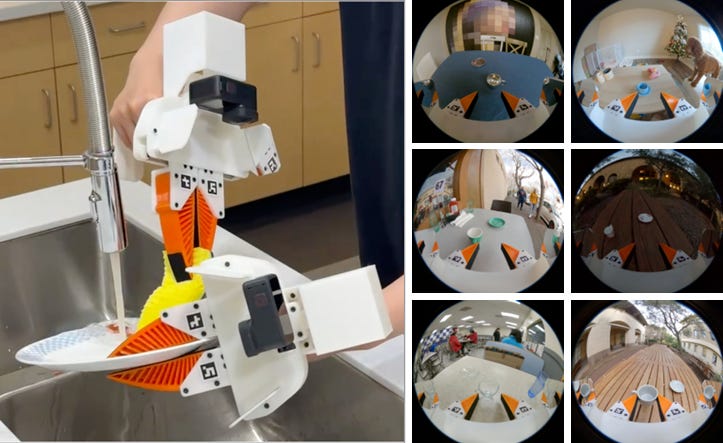
How to Train Your Robot

How to Train Your Robot

The enormous advance in AI capabilities over the last several years has in large part been driven by the availability of vast amounts of training data.