Sign up

Armin Ronacher's Thoughts and Writings
Text • Armin Ronacher

What is Codemode

More than a year ago I wrote a few posts here that recommended people not to load custom tools into their context (or MCP servers) but to just use more scripts. Most importantly I wrote that Code Is All You Need and I wrote about that MCP needs code. With Pi 1.0 we now add...

Pluralistic: Daily links from Cory Doctorow
Text • Cory Doctorow

Pluralistic: Swapping money for expertise (06 Oct 2026)

Today's links Swapping money for expertise: Money can't buy me love. Hey look at this: Delights to delectate. Object permanence: "Tempo"; Yahoo censors MEP's torture debate video; Scotland's money-laundry; A textbook scam; DOS the IRS then charge for access; Just trying to ma...

Terence Eden’s Blog Valid
Text • Terence Eden

Una Watch - SDK and Writing Your First App

I don't know why hardware manufacturers find it so hard to write decent documentation. As I've said before you need to actually test your readme. The Una Watch development instructions are scattered across a bunch of different files. So here's how to go from zero to your first "Hello, World!" Glance app with the minimum of fuss. This all assumes a fairly modern Debian / Ubuntu / Pop OS Linux. …

The Silicon Underground
Text • Dave Farquhar

Lotus: Second largest software publisher in the world (in 1983)

Lotus: Second largest software publisher in the world (in 1983)

On October 6, 1983, Lotus Development held its very successful IPO worth $5.5 billion. Founded by Mitch Kapor and Jonathan Sachs in 1982, Lotus was the publisher of a spreadsheet called Lotus 1-2-3. Two months after their IPO, they were

The post Lotus: Second largest software publisher in the world (in 1983) appeared first on The Silicon Underground.

Entropic Thoughts Supports Webmention
Text • kqr

Predicting Peace

I have long struggled with predicting when peace will occur. Actually, I’m struggling with predicting anything relating to war, but let’s focus on when peace arrives for now. There are two such questions in the current ACX 2026 competition:

  • Will there be a cease-fire in Ukraine in 2026?
  • Will there be a cease-fire in Sudan in 2026?

When I entered my forecast for these questions, I did it based on Laplace’s rule of succession, i.e. as a function of their duration only. This is sort of justified if war durations are heavy-tailed, which would mean that the longer they go on for, the less likely it is that peace comes soon. But I don’t know if that is true.

(Continue reading the full article on the web.)

Anil Dash Valid
Text

We are going to kill “unalive”

I talk to a lot of old people, those who were born in the 20th century, and if I ask them what the word “unalive” means, they usually have no idea what I’m talking about, except for some of them who have kids or who study Internet culture. This will, of course, probably seem...

The Old New Thing
Text • Raymond Chen

If somebody tries to hot-patch an already-hot-patched function, how do they avoid conflicts?

Hot-patching is for Windows, not for you.

The post If somebody tries to hot-patch an already-hot-patched function, how do they avoid conflicts? appeared first on The Old New Thing.

Tedium: The Dull Side of the Internet. Updates instantly via WebSub
Text • Ernie Smith

Missing Link

Some spare thoughts about Link, a newspaper that turned 20 years old today—but more or less changed my life. It's been 18 years, but I still miss that job.

Simon Willison's Weblog Supports Webmention
Text

Quoting Felix Rieseberg

The "old" version of Cowork runs model inference in the cloud, executing tool calls in an Anthropic-provided VM we shipped to your computer. We added the VM for capability, safety, and security reasons - mapping in just the data you explicitly added to your session. People ...

Pluralistic: Daily links from Cory Doctorow
Text • Cory Doctorow

Pluralistic: Scrutinized (05 Oct 2026)

Today's links Scrutinized: Pervert glasses vs the authentic self. Hey look at this: Delights to delectate. Object permanence: DRM-free in the UK; Maple-leaf roses; Italian Wikipedia shuts down; Vancouver's property speculator tax works; Ex-Soviet leftists launch "September"; ...

Maurycy's Blog
Text

The indicators of a quality website (somewhat silly)

You know it's a good website when it: Uses subdomains (except for username.platform.com)... especially multiple levels Has a non-standard port number in URL Is served over a plaintext connection Uses very nearly default styles All tag names are written in SCREA...

Simon Willison's Weblog Supports Webmention
Text

Qwen3.8 27B addition in words

Research: Qwen3.8 27B addition in words Colin Frasier posted on Bluesky about an experiment he ran over two years ago using GPT-4o to see how well it could "compute the sum but return the answer in words" across increasingly large numbers. Here's the chart he shared ...

matklad
Text • Alex Kladov

Benchmark In Milliseconds

How long should a micro benchmark run? My rule of thumb is to tweak the input size until the benchmark takes about 300ms, for the following reasons:

Terence Eden’s Blog Valid
Text • Terence Eden

[RSS Club] Changes to the RSS and Atom feeds

This content is exclusive to RSS and Atom subscribers. It is not on the web. Shhhhh! A few weeks ago I accidentally broke some of your feed readers. I was using <![CDATA[ … ]]> blocks in the feed. That allows me to put in raw HTML without the need for escaping. Unfortunately, some feed readers unescaped text which should have remained escaped. Confusing, innit? Anyway, if you've a mind to, I'd b…

The Silicon Underground
Text • Dave Farquhar

The IBM Thinkpad’s 1992 debut

The IBM Thinkpad’s 1992 debut

On October 5, 1992, IBM released its first three Thinkpad models. IBM had portable computers before, starting with its luggable Portable PC from 1984 and PC Convertible from 1986. But none of them had the lasting success of the Thinkpad,

The post The IBM Thinkpad’s 1992 debut appeared first on The Silicon Underground.

Miguel Grinberg's Blog
Text • Miguel Grinberg

How fast is Python 3.15?

It's October once again, and that means it is time to take the new release of Python for a spin. As I did with my Python 3.14 performance article of a year ago, today I'm sharing a new run of my informal Python benchmark, comparing Python 3.15 against previous interpreters all the way back to 3.10.

If you are not interested in the charts and the tables and just want to read my analysis, feel free to jump to the conclusions section at the end.

Jim Nielsen’s Blog Valid
Text

“I’m Embarrassed on Behalf of the Tech Industry”

That’s something Ben Thompson said a recent episode of Dithering. He was referring to how he felt while trying to help his mom get control of her digital life. Everything was just too hard and convoluted and he felt embarrassed as someone who works in tech.

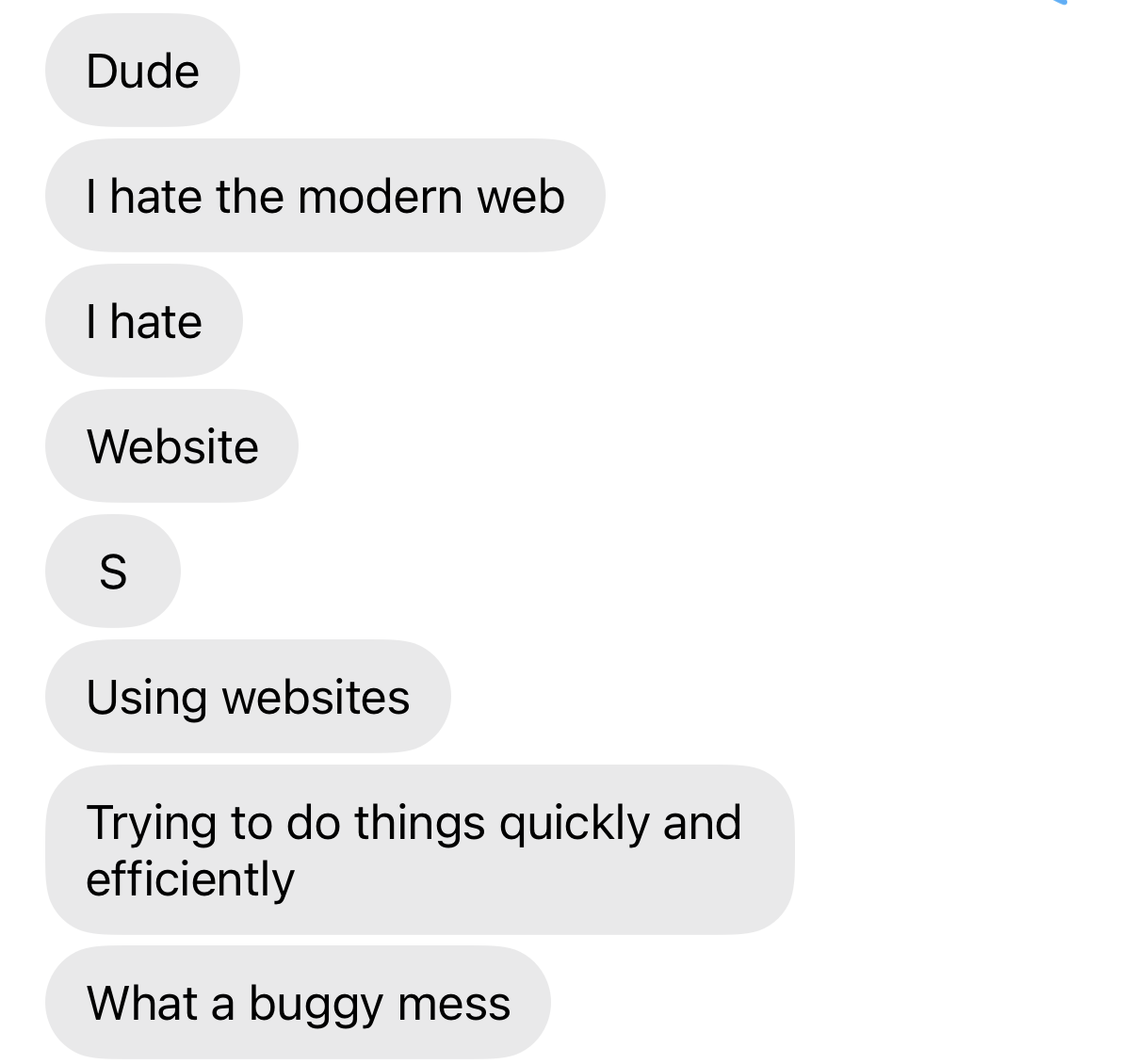
That very same evening, I randomly got this text from a family member.

Text message reading: “Dude. I hate the modern web. I hate. Website. S. Using websites. Trying to do things quickly and efficiently. What a buggy mess.”

I hear this a lot from family and friends who sit outside tech.

“Nothing works.”

“Everything is hard to use.”

“I can’t make sense of this.”

And to them I am a representative, a connection, to this pain in their lives.

And I, too, am embarrassed on behalf of the tech industry — by our collective failure.


Reply via: Email · Mastodon · Bluesky

Marcus on AI
Text • Gary Marcus

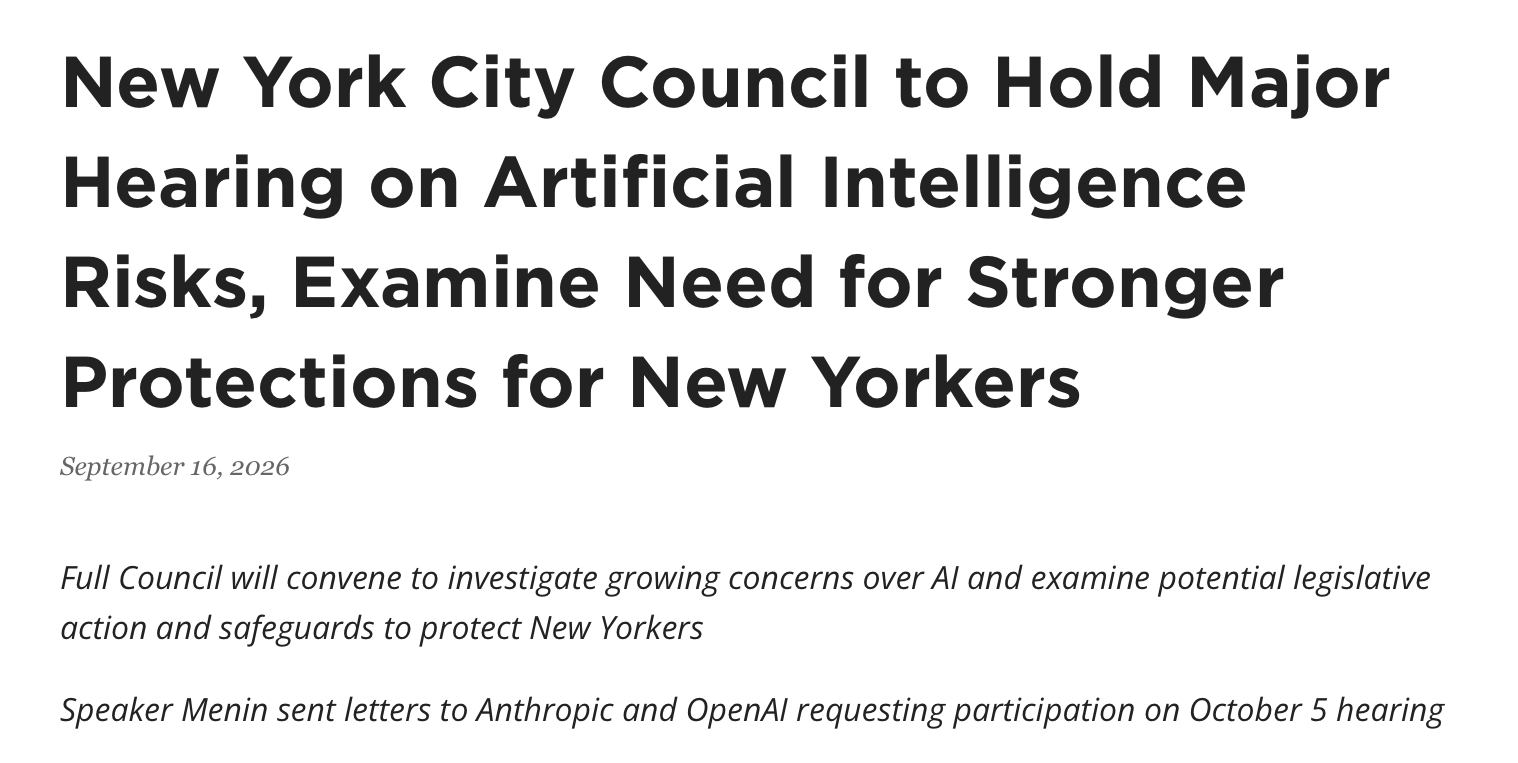
Coming soon: New York City’s hearing on AI risks

Coming soon: New York City’s hearing on AI risks

New York tries to take care of its own

Xe Iaso's blog Valid
Text

How to Solve: AAC Heavyweight M1 (Savage)

FFXIV raid mechanics explained in plain language.

Abort Retry Fail Valid
Text • Bradford Morgan White

Zenith Data Systems, Part I

Zenith Data Systems, Part I

The quality goes in before the name goes on