The Daily
• The New York Times
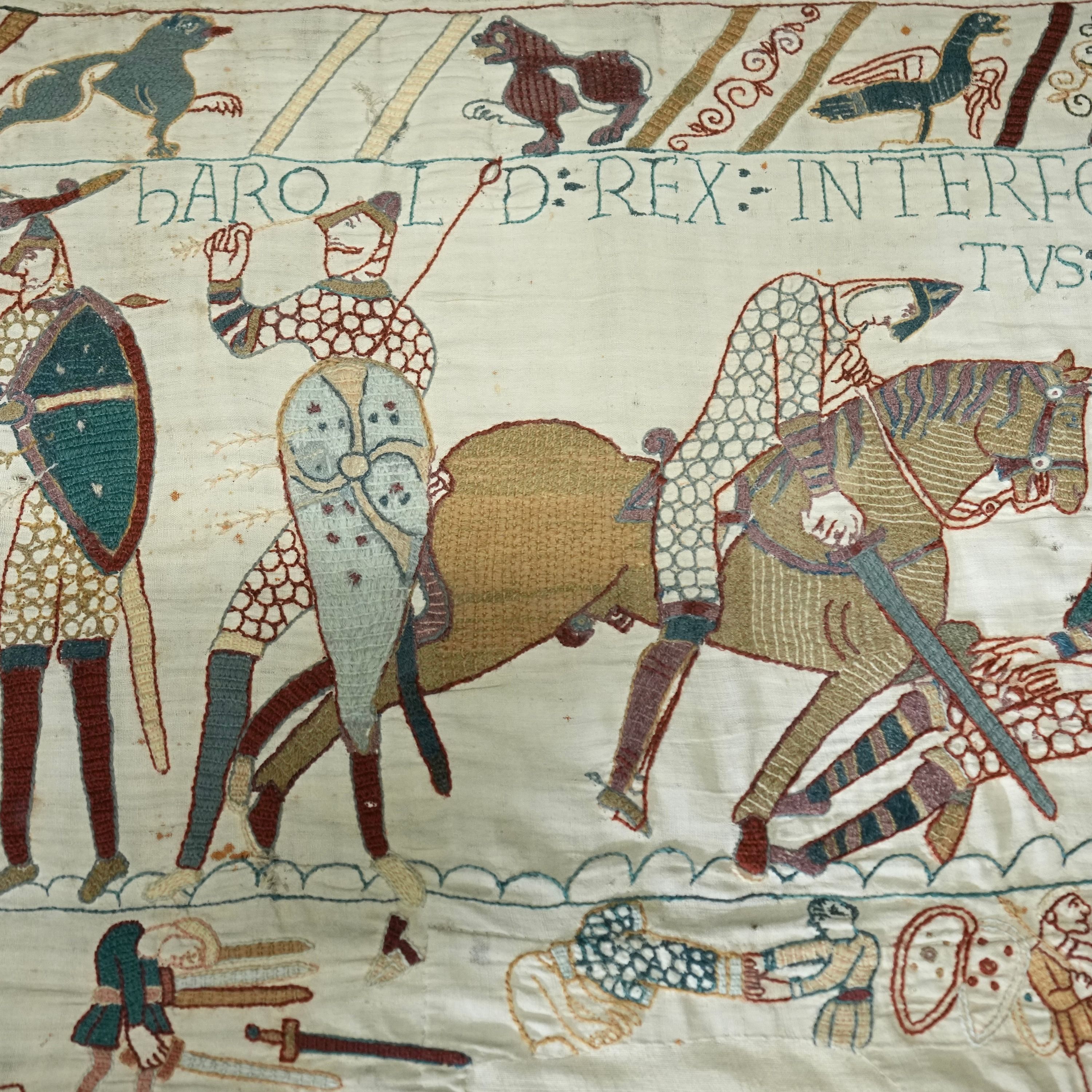
How a 1,000-Year-Old Tapestry Took London by Storm
The Daily
• The New York Times
Ars Technica
• Jacek Krywko
Isotope ratios provide a hint that the giants were actively managing temperatures.
escarpment
• lnebres
Or, the process of anchoring language to the real world.
Which is basically what this weblog writing praxis is all about. (And which the other one from a year or so ago was and, of course, the ur-blog over at TFR from decades ago now.)
[ in progress... ]
Ars Technica
• Jacek Krywko
Isotope ratios provide a hint that the giants were actively managing temperatures.
Seth's Blog
• Seth Godin
The sensitivity analysis for a decision is easy to overlook, because we tend to focus on the expected outcome. Perhaps it makes sense to begin with the edges instead. Upside: If this works, really works, what are the implications? Downside: If this fails, totally, what are the costs? After we understand the edges, then it […]
WIRED
• Marlowe Starling
Several new studies have uncovered this long overlooked aspect of coral physiology that could be the key to the animals’ fate in a changing climate.
The Lever
• David Sirota
An AI apocalypse involving killer robots is terrifying, but don’t overlook a speculative bubble whose collapse will reverberate across the economy.
Roy Lichtenstein, Bull VI, 1973 #roylichtenstein #tatemuseum
The Lamb, 1920 #paulklee #surrealism
La machine à privilèges, 1964 #brauner #romanianart
Letters from an American
• Heather Cox Richardson
On September 19, 1676, three hundred and fifty years ago today, Nathaniel Bacon and his followers burned Jamestown, the capital of the Virginia Colony.
@Neil29688176 Great! Here's an account for Andre Masson @artistmasson. Thanks for following, @ItsCodyBraun
A blue house, 1902 #expressionism #picasso
A growing Bundibugyo virus outbreak is showing how a little-known relative of Ebola can become a major threat when diagnosis and treatment options are limited. Experts warn that preparing only for familiar pathogens could leave the world vulnerable when rare but deadly viruses suddenly reemerge.
A massive crater on Mars’ moon Phobos may hide a dense region of compressed material that could reveal whether the moon is a captured asteroid or debris from an ancient impact on Mars. Japan’s upcoming MMX sample return mission could provide the measurements and physical evidence needed to solve the mystery.
Nearly three decades of Hurricane Hunter data reveal four features that can help a tilted tropical cyclone straighten its circulation and become capable of intensifying. The findings could give forecasters an earlier warning that a seemingly disorganized storm is becoming primed to strengthen.
Complex systems may work better when their parts are not perfectly alike. Northwestern physicists found that carefully balanced variation, or “disorder,” can make networks such as power grids, ecosystems, neurons, and materials more stable. Even random differences sometimes improved stability compared with completely uniform systems. The discovery could help researchers design more resilient technologies and explain why natural systems are so rarely perfectly uniform.
A chemical that stops drywood termites from building new exoskeletons killed about 95% of colonies in testing, offering a potentially safer alternative to traditional fumigation. Because termites eventually have no choice but to molt, the treatment turns a normal stage of their life cycle into a fatal weakness.