
It came after ud0 and ud1.
The post Why is the x86 undefined instruction called <CODE>ud2</CODE>? Why 2? appeared first on The Old New Thing.

The Old New Thing
• Raymond Chen
It came after ud0 and ud1.
The post Why is the x86 undefined instruction called <CODE>ud2</CODE>? Why 2? appeared first on The Old New Thing.

Dwarkesh Podcast
• Dwarkesh Patel
“We're nowhere near the ceiling.”

Pluralistic: Daily links from Cory Doctorow
• Cory Doctorow
Python 3.15 release manager Hugo van Kemenade describes how in the upcoming 3.15 release soft deprecation has come for the venerable but deeply confusing re.match() function. It's now available with the much clearer alternative re.prefixmatch() name - reflecting how it anchors at the beginning of the string but not the end.
Most of the time you probably want re.search() (match this pattern anywhere in the string) or re.fullmatch() (match the entire string) instead.
Via Lobste.rs
Tags: python, regular-expressions

Tedium: The Dull Side of the Internet.
• Ernie Smith
Making sense of iLands, the company whose AI agents emailed me half a dozen times in two days offering to do my research. Turns out they're just bots trying to keep their own lights on by trying to take my job.
The Old New Thing
• Raymond Chen
Not through normal means.
The post How can I remove the Close button from my window caption? appeared first on The Old New Thing.

Construction Physics
• Brian Potter

Construction is famously labor intensive: direct labor makes up close to 50% of the cost of constructing a new single-family home in the US, compared to around 6 to 8% of the cost of manufacturing a car.

Terence Eden’s Blog
• Terence Eden
If you're reading this, you're part of RSS Club! A top secret society of cool people who subscribe to my feed. This post is not available on the web or via email. I've been playing about with Rogue Scholar. It's an open-access publication which allows blogs to get a persistent Digital Object Identifier. If I've set everything up correctly (not a given) then all new posts on this site will be…

The Silicon Underground
• Dave Farquhar

The Atari 2600 was first released on September 11, 1977, along with nine titles. It wasn’t the first home video game console to connect to a TV and it wasn’t even the first one to use cartridges, but it was
The post Atari 2600 launch titles appeared first on The Silicon Underground.
Datasette 1.0a39 and 0.65.4 security releases
Today we're releasing two new security patch versions of Datasette: 1.0a39 and 0.65.4 - one for the current alpha series and one for the stable 0.65.x family.These are security fixes which you should apply if you are running a Datasette instance on the public web - in particular if that instance mixes both public and private tables.
Following issues reported by Sevban Dönmez, Alex Garcia and I ran an extensive audit of Datasette using Claude Fable 5.1, GPT-5.6, and GPT-6 Astra. We then spent almost a week collaborating on and reviewing the fixes.
They helped find some very subtle bugs. We'll be incorporating security audits by frontier models into all of our development work going forward.
Tags: releases, security, ai, datasette, generative-ai, llms, ai-security-research

Marcus on AI
• Gary Marcus
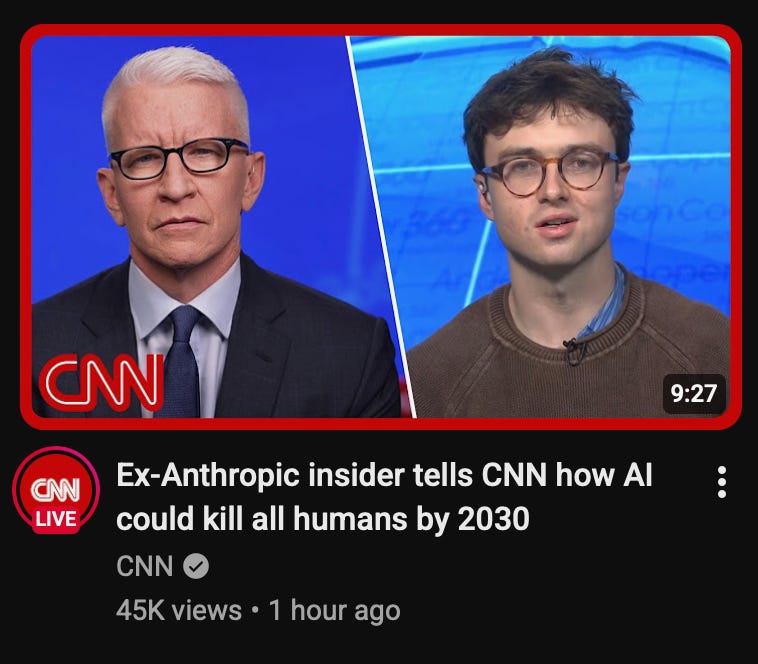
AI is already causing harms, there are are many real risks, but constant focus on absurd end-of-the-world fantasies has made the situation worse

Terrible Software
• Matheus Lima
AI-generated work can look finished without being understood. That uncertainty erodes trust, slows reviews, and leaves colleagues doing the missing work.
Andrew Nesbitt
• Andrew Nesbitt

min-release-age, minimum-release-age, -Zmin-publish-age, cooldown.

John D. Cook
• John
The Greek letter β (beta) and the German letter ß (eszett) look similar, especially in some fonts. Now suppose an OCR program sees some character that could be a beta or could be an eszett. It could calculate some kind of distance between between the pixel pattern of the character and the pixel patterns of […]
The post Bayesian OCR first appeared on John D. Cook.
Terence Eden’s Blog
• Terence Eden
For years, I've had a test-card at the start of my slides. Before I start my talk, I can immediately see if the aspect ratio is wrong, colours are off, or any other visual issues with the presentation. A few years ago I was invited to give a talk and was assured that the venue was set up for audio as well as video. I dutifully filled my slides with with demo videos containing sound. None of…
