Imagining how to report a memory allocation failure for a sparse page.
The post Why don’t we allow stacks to be sparse, instead of forcing them to be contiguous? appeared first on The Old New Thing.

The Old New Thing
• Raymond Chen
Imagining how to report a memory allocation failure for a sparse page.
The post Why don’t we allow stacks to be sparse, instead of forcing them to be contiguous? appeared first on The Old New Thing.
Andrew Nesbitt
• Andrew Nesbitt

Small Go modules for people who build package-manager tooling.

Terence Eden’s Blog
• Terence Eden
Here's a problem that I've found with ActivityBot - my little ActivityPub server. Sometimes it receives messages which were originally sent months ago. Why does that happen and is it risky to accept and process them? My tl;dr is that it probably isn't worth worrying about. But I'd love someone to tell me why I'm wrong. Here's my thinking: Table of ContentsCausesIs that a problem?What are we…

The Silicon Underground
• Dave Farquhar

Compuserve was an online service for dialup modems from the 1970s to the 1990s. It was a way of getting online and communicating with others before the Internet was generally available to individuals. Later, it became a primary way for
The post What happened to Compuserve? appeared first on The Silicon Underground.
TL;DR: we spend more CPU cycles rendering commits for scrapers than we spend on all other kinds of legitimate access, including git clones. At any one time, across 5 geo-distributed nodes, there are 14 CPU cores doing nothing but rendering git commits as html.
I worry about this a lot from the perspective of Datasette, which serves a huge number of crawlable web pages.
Via Hacker News
The strongest argument I see for continuing to train much smarter models quickly is the need to build defensive systems against the dangers posed by other AI. [...]
We will need powerful, aligned AI for defense; to secure infrastructure, to protect against rogue agents in real time, and to invent entirely new protective measures. This will be a primary focus of OpenAI’s deployment efforts.
At the same time, even with the uncertainty that comes from anticipated broad AI progress and the need to build defensive systems, we must not let that become an excuse for recklessness. The idea of racing forward at all costs seems absurd once one internalizes the seriousness of the stakes.
— Jakub Pachocki, Chief Scientist at OpenAI
I was debugging an issue and I found a link to my blog!
Interviewing a senior software engineer
Biggest challenge so far in any coding project?
My biggest challenge isn't code per se. It is explaining to someone else what I am trying to do with the code. It is surprisingly hard to convert the thoughts in my head (or the code) into something coherent someone else can understand.
I still believe that. I don't even remember when we had this discussion, but I'm glad Walter has kept it up. And a great reminder of my priorities.
If you weren't coding, what would you be doing?
I'd be a writer. (not a good one, but one nonetheless)
Yep.

Tool: Video compressor
I recorded a short demo video of my Equal Earth animation on my phone and wanted to publish an optimized version of that video (using FFMPEG) on my blog, so I had Claude Fable 5.1 in Claude Code for web build me this tool using the WebAssembly build of FFMPEG.
Tags: ffmpeg, video, webassembly, claude, claude-code, claude-mythos-fable
Tool: Mercator ↔ Equal Earth
I got curious about the Equal Earth map projection that was recently voted on at the UN so I had GPT-6 Astra (medium) in ChatGPT Work build me this animated transition between Mercator and Equal Earth using D3.
Tags: geospatial, d3, vibe-coding, gpt-6-astra

lcamtuf’s thing
• lcamtuf

Raymond Chandler would have loved generative AI
How and why I went from AI optimist to AI doomer.

John D. Cook
• John
The Online Etymological Dictionary gives the following etymology for grok: grok (v.) “understand empathically,” 1961, an arbitrary formation by U.S. science fiction writer Robert A. Heinlein (1907-1988) in his book “Stranger in a Strange Land.” In the book it is a transliteration of a Martian word and is said to mean etymologically “to drink.” It attained […]
The post Ngram error rate first appeared on John D. Cook.
The Silicon Underground
• Dave Farquhar

On September 6, 2001, HP announced its intention to acquire Compaq for $25 billion. It was a stunning end for what still seemed to be one of the rising stars of the PC industry. I also think it proved that
The post The ill-fated HP-Compaq merger appeared first on The Silicon Underground.
Zondag 6 september mocht ik voor het Paradisodebat van Kunsten ‘92 de aftrap geven voor twee uur discussie over AI. Er is een uitstekende video-opname van het hele evenement (link naar mijn bijdrage). Ik ben de organisatie erg dankbaar voor de uitnodiging voor dit publiek te spreken.
Voor mij als nerd uit de tech scene was dit een heel fijn uitstapje, eens “gluren bij de buren”. Want daar word je altijd wijzer van.

Pluralistic: Daily links from Cory Doctorow
• Cory Doctorow
Research acceleration: The view inside OpenAI
Apparently today is RSI day at OpenAI, for Recursive Self-Improvement - I think it's their new AGI. Both this piece and the new essay An Alien Mind (by Chief Scientist Jakub Pachocki) talk about it, and this one doesn't even bother to expand the acronym.Included are details on how OpenAI's own research team are using coding agents. Like pretty much everyone else 2026 has been the year that agentic engineering really took off at OpenAI, best illustrated by this chart:
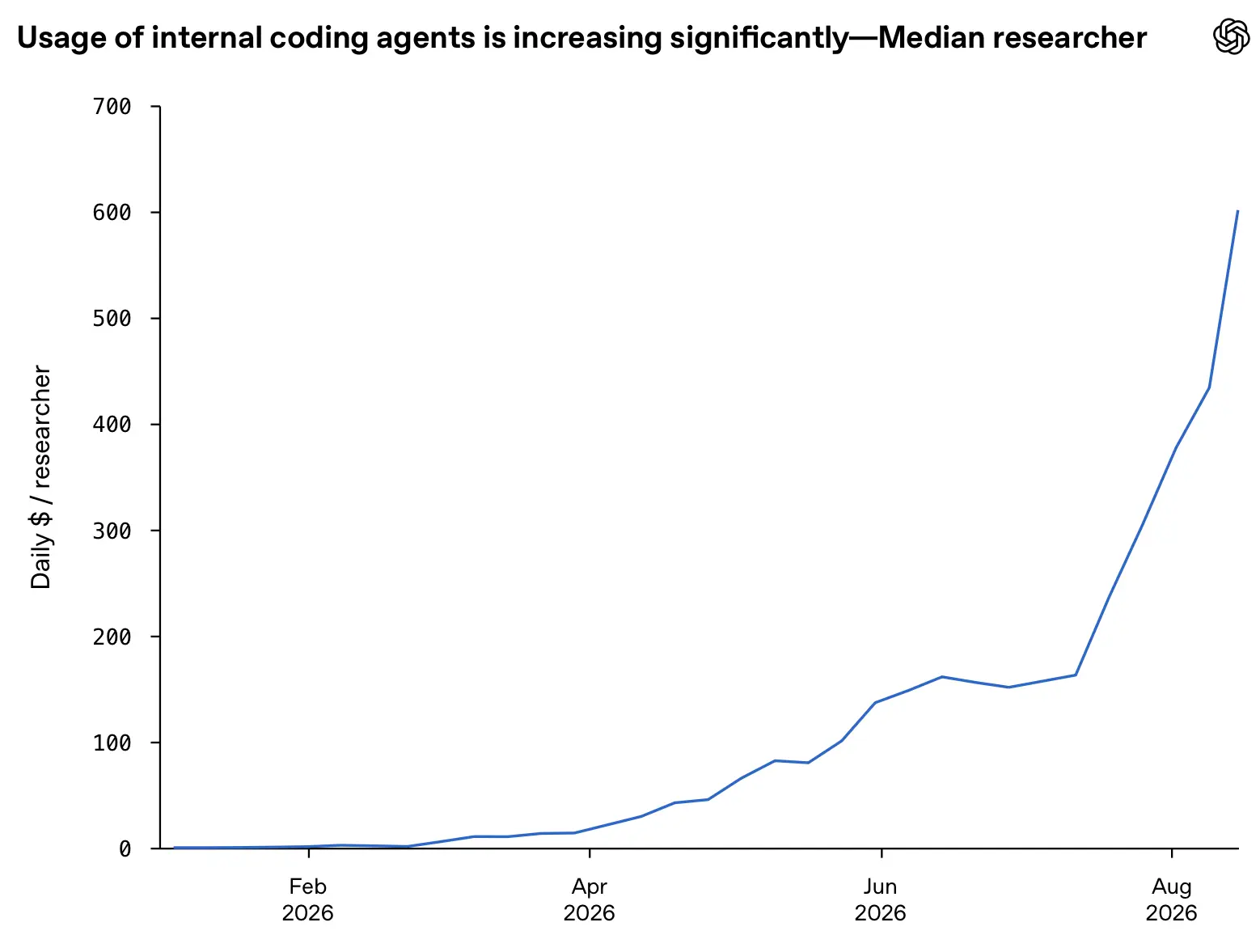
I'm intrigued at what caused that significant acceleration in AI spend per researcher in late July - my best guess is that's when internal employees gained access to the model later released as GPT-6 Astra.
Tags: ai, openai, generative-ai, chatgpt, llms, coding-agents, november-2025-inflection, recursive-self-improvement