Pluralistic: Daily links from Cory Doctorow
• Cory Doctorow
Pluralistic: The actual epistemic crisis (20 Aug 2026)
Marcus on AI
• Gary Marcus
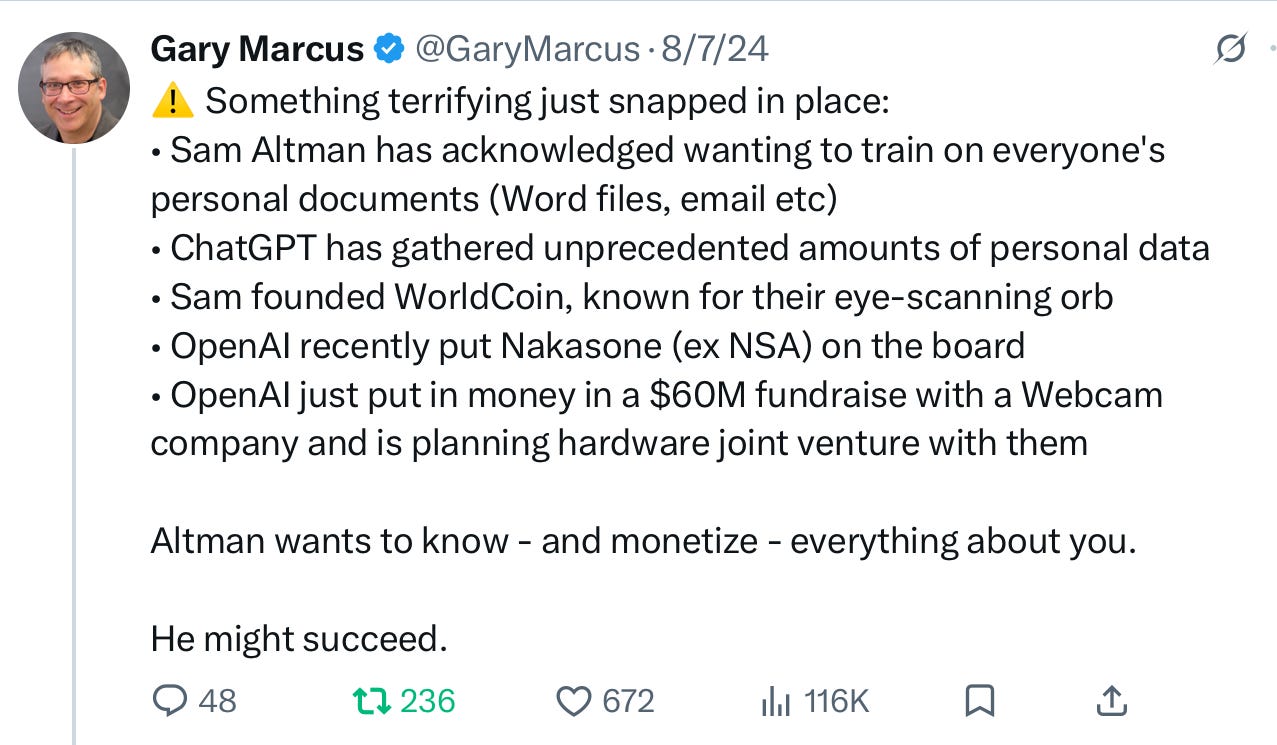
OpenAI is becoming a surveillance company
It’s not even really trying to hide it
A shot-scraper-style JSON API on Bun 1.4's new Bun.WebView
matklad
• Alex Kladov
Better Batteries
One of the eternal schisms in programming is over the question of whether the standard library should be minimal or encompassing. This is the wrong question to ask. The right one is:
Introducing Dashboard Touch, a build-your-own version of Touch ID
Marcus on AI
• Gary Marcus
Leopold’s Folly
How what one young man did might come to symbolize an entire era
A Sloppy Interface Is a Security Liability 
Jeff Geerling
• Jeff Geerling
Getting the Steam Deck LCD working on a Raspberry Pi
The BOE TV070WXM-TV0 LCD used in the original Steam Deck can be had for around $30. It's a serviceable 7" touchscreen with 400 nits of brightness and a resolution of 1280x800 (for a sharp 216 ppi).
The specs are a lot nicer than the Pi 7" Touch Display, which costs twice as much, with giant bezels and half the resolution!
Until today, the Steam Deck LCD didn't work with a Raspberry Pi. But the folks at Scandent were trying to standardize on a mass-market touchscreen for one of their own devices, and built a Linux kernel driver for it which they intend to upstream.
John D. Cook
• John
AI-generated ASCII diagrams
I like AI-generated ASCII diagrams. Because nobody would ask AI to generate ASCII diagrams, and so, it’s congruous. I like incongruity [1]. Aside from the incongruity of using a gazillion-parameter neural network to make 1970’s style ASCII art, ASCII diagrams have some uses. They’re absolutely tiny compared to image files. But more importantly they can […]
The post AI-generated ASCII diagrams first appeared on John D. Cook.
Andrew Nesbitt
• Andrew Nesbitt
Issues in the Repo
refs/bugs, refs/notes, refs/heads/ticgit, or a directory full of YAML.
The Silicon Underground
• Dave Farquhar
Adobe Systems IPO August 20, 1986
On August 20, 1986, Adobe Systems held its initial public offering. Priced at around $11 per share, Adobe has split its stock six times since. Adobe: The sleeper tech stock of 1986 1986 was a good year for tech stocks.
The post Adobe Systems IPO August 20, 1986 appeared first on The Silicon Underground.
Our Servants Will Do That For Us
Why the post-scarcity utopia is unlikely.
Marcus on AI
• Gary Marcus
Breaking: The Republican party is panicking over its ties to Big Tech
And panicking with good reason
The Old New Thing
• Raymond Chen
On wrapping a callable in a lambda that just calls it with the same parameters
Just use the callable directly.
The post On wrapping a callable in a lambda that just calls it with the same parameters appeared first on The Old New Thing.
smolmachines / smolvm as a sandbox for untrusted Python & JavaScript
Quoting Jeremy Morrell
My hypothesis is that there is a new opportunity for Extensible Software on the web. LLMs radically lower the cost of authoring extensions, and modern sandbox primitives lower the deployment cost and provide good security boundaries. We can build our app as a solid, accountable core, and allow users to safely extend it in many directions by having LLMs fill in the missing pieces. We can give our users super powers.
— Jeremy Morrell, Extensible Software in the age of LLMs
Tags: sandboxing, llms, ai, generative-ai
Conceptual integrity and counting lines of code
Anubis continues to expose new ways people configure webservers
TL;DR: if admins turn off browser features, those features won't work in confusing ways that are annoying to debug
Armin Ronacher's Thoughts and Writings
• Armin Ronacher