Sign up

seangoedecke.com RSS feed
Text

You don't have to be smart if you can think clearly

When you’re on fire, problems are transparent: they’re solved simply by the act of looking at them. Even complicated layers of multiple problems can simply be glanced through like stacked panes of glass. But nobody can work that way all the time. This is a common pitfall for...

Simon Willison's Weblog Supports Webmention
Text

Discovering cryptographic weaknesses with Claude

Discovering cryptographic weaknesses with Claude The best part of this article (here's the repo) about how Anthropic researchers used Claude Mythos to find mathematical flaws in both HAWK and a weaker version of AES ("neither of these results has a practical impact on today’...

Simon Willison's Weblog Supports Webmention
Text

Quoting Akshat Bubna

We’re aware a Modal customer published an unauthenticated endpoint that allowed ​anyone on the internet to use ​their ⁠sandboxes for code execution. This was used by the rogue agent. Modal’s ⁠platform ​or isolation were not ​compromised in anyway.

— Akshat Bubna, Modal's CTO, talking to Reuters about this incident

Tags: ai-security-research, openai, sandboxing, security, openai-hugging-face-incident

Simon Willison's Weblog Supports Webmention
Text

uv 0.12.0

uv 0.12.0 Some interesting breaking changes in this release of uv, in particular to the default project produced by the uv init command. uv init is the uv shortcut for creating a new project. The previous version of uv, version 0.11.x, produced this directory when you ran uv...

Simon Willison's Weblog Supports Webmention
Text

Anatomy of a Frontier Lab Agent Intrusion: A Technical Timeline of the July 2026 Incident

Anatomy of a Frontier Lab Agent Intrusion: A Technical Timeline of the July 2026 Incident Hugging Face just released this extremely detailed technical description of OpenAI's recent accidental cyberattack against their infrastructure. This attack was very sophisticated, and ...

Fernando Borretti Valid
Text

When The Future Doesn’t Need Us

What does the world look like when AI outcompetes humans?

Marcus on AI
Text • Gary Marcus

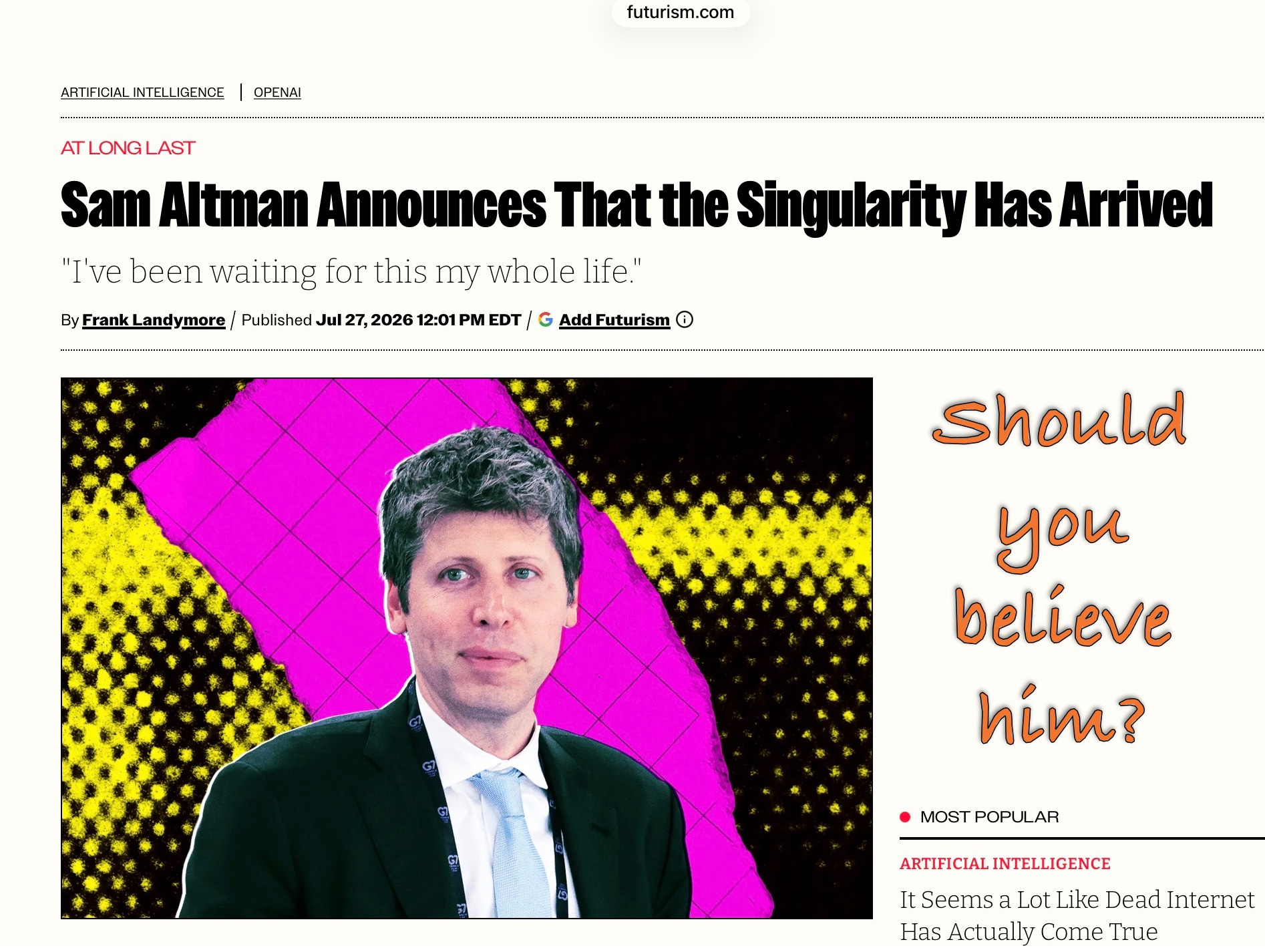
Sorry, Sam and Elon, we have not reached the Singularity

Sorry, Sam and Elon, we have not reached the Singularity

Not that anyone even knows what that means.

DYNOMIGHT Valid
Text • dynomight

Does every question mark deserve a Betteridge?

An essay that may or may not reach a firm conclusion

John D. Cook
Text • John

Inverse factorial improved

A couple years ago I wrote about how to compute the inverse of factorial. I used that code in writing the previous post because the post required solving the equation ⌊log2(n!)⌋ = b given b. That is, given a number of bits b, find the smallest value of n such that n! > 2b. What the […]

The post Inverse factorial improved first appeared on John D. Cook.

Max Bernstein's Blog
Text

The inliner is yielding benefits for ZJIT

Originally published on Rails At Scale. We recently enabled a really cool feature in ZJIT that makes it feel like a Real Compiler™: the inliner! We’ll write more about it soon. In this post, we’ll talk about one excellent concrete benefit we are already seeing and how it op...

Simone Salis Supports Webmention
Text • Simone Salis

The Photographer Who Takes No Pictures

The Photographer Who Takes No Pictures

How a trip in 2012 transformed my relationship with photography—from staged performances to capturing genuine moments that matter, for engagement rather than validation.

John D. Cook
Text • John

Cryptographic Keys and Decks of Cards

The previous post looked at the idea of storing a cryptographic key in the order of a deck of cards. A deck of 52 cards can store 225 bits of data because ⌊log2(52!)⌋ = 225. Here ⌊x⌋ is x rounded down to the nearest integer. If we want to store bigger keys, we’re going to need […]

The post Cryptographic Keys and Decks of Cards first appeared on John D. Cook.

Andrew Nesbitt Valid
Text • Andrew Nesbitt

Why npm Dependency Trees Are So Big

Two versions of lodash walk into a tree

Terence Eden’s Blog Valid
Text • @edent

Google Calendar "Unable to launch event" - caused by missing DTSTAMP

For several years, Google's product help forums have been littered with people trying to download a .ics event from their email, only to receive the error "Unable to launch event" when trying to add it to Google Calendar. It doesn't happen with all iCal attachments, only some. Here's how to fix it. I checked dozens of broken iCalendar invites using this iCal validator and they all had the same …

The Silicon Underground
Text • Dave Farquhar

IBM PS/2 E: The first Energy Star computer

IBM PS/2 E: The first Energy Star computer

On June 29, 1993, IBM released the first energy star computer, the IBM PS/2 E. The “E” stood for energy. But while it was undeniably more efficient than other desktop PCs, arguably it was a PS/2 in name only. To

The post IBM PS/2 E: The first Energy Star computer appeared first on The Silicon Underground.

Pluralistic: Daily links from Cory Doctorow
Text • Cory Doctorow

Pluralistic: Discernment (28 Jul 2026)

Today's links Discernment: How can you fact-check AI when you're asking it to teach you something you don't understand? Hey look at this: Delights to delectate. Object permanence: How to help with computers; Batman equation; Fuck and the law; NC's racist voting law; Pregancy ...

<antirez>
Text

The real AI risk is inside the labs

http://antirez.com/news/172

Amodei in his latest blog post wrote a mix of agreeable things and things that I believe misrepresent where the real risk of AI is located. I want to focus my attention on why, among all the risks, open weight models constitute the mildest one. I write these words as a person...

Simon Willison's Weblog Supports Webmention
Text

moonshotai/Kimi-K3

moonshotai/Kimi-K3 As promised earlier this month, Moonshot have released the weights for their excellent 2.8 trillion parameter Kimi K3. They're a hefty 1.56TB on Hugging Face. Kimi introduced their own janky modified version of the MIT license with K2 back in July 2025. Th...

John D. Cook Valid
Text • John

Hiding data in permutations

The latest issue of Paged Out! has an article by Stephen Hewitt “An off-line backup of your cryptographic key using playing cards.” The idea is to use a deck of 52 to store a 128-bit cryptographic key. To erase the key, shuffle the deck. Hewitt gives his algorithm for embedding a key, one that can […]

The post Hiding data in permutations first appeared on John D. Cook.

Simon Willison's Weblog Supports Webmention
Text

An opinionated guide to which AI to use to do stuff

An opinionated guide to which AI to use to do stuff It's interesting watching the evolution of Ethan Mollick's guide over time. A year ago it was still all about chat - ChatGPT, Claude, Gemini - with o3, Claude 4 Opus, and Gemini 2.5 Pro as the models and Deep Research as a...