
davewiner's subscription list, hackerNewsStars category. List created by feedlandDatabase v0.8.16.


Armin Ronacher's Thoughts and Writings
• Armin Ronacher
The Tower Keeps Rising
I feel that some vibecoded software changes somewhat randomly and unexpectedly.
That made me think about Bruegel’s “The Tower of
Babel” which shows
an already quite chaotic depiction of the Tower of Babel. The story is usually
told as one about pride and ambition and ultima...

DYNOMIGHT
• dynomight
Pseudpocalypse

How to discount your expectations

John D. Cook
• John
ICD-10 chapters and code letters
I’ve been thinking about ICD-10 codes; they come up a lot in my work. The ICD-10-CM standard is divided into 21 chapters, which generally correspond to the first letter of a code. However, a chapter may contain blocks beginning with more than one letter, and codes starting with a single letter, namely D, can span […]
The post ICD-10 chapters and code letters first appeared on John D. Cook.
Marcus on AI
• Gary Marcus
Breaking: Demis Hassabis endorses preflight safety testing for AI

Good news, for once.

The Old New Thing
• Raymond Chen
Microspeak: Double-click and drill down
Please, tell me more.
The post Microspeak: Double-click and drill down appeared first on The Old New Thing.

Terence Eden’s Blog
• @edent
I'm a USB-C Maximalist
My wife and I recently went on a 7 week holiday around Europe. Although we each took a massive backpack, we wanted to travel fairly lightly. I took a single universal power brick. This little unit was all I needed to charge my various gadgets. It has a hefty USB-C PD (Power Delivery) port for rapid charging of my phone and laptop. Two other USB-C ports for my other gadgets. And a couple of…

Pluralistic: Daily links from Cory Doctorow
• Cory Doctorow
Pluralistic: Gerontocracy's failure mode (14 Jul 2026)
Today's links Gerontocracy's failure mode: Where are the designated survivors? Hey look at this: Delights to delectate. Object permanence: MSFT v MP3; UK industry v schoolkids; Gary Larson v comics sharing; Planned LED obsolescence; PoGo v Black neighborhoods; Gnarlier trolle...

What does "playing politics" mean for software engineers?
Software engineers are often told to “start playing politics”, but most engineers have no idea what that means.
Their reference point for “playing politics” comes from fiction like Game of Thrones. Are they supposed to raise an army and depose the CEO, or poison each other a...

The Silicon Underground
• Dave Farquhar
Nintendo Famicom and the secret of Nintendo’s success

On July 15, 1983, the Famicom, or Family Computer, launched in Japan. Despite the name, the Family Computer was a game console, and it went on to shatter the Atari 2600’s record for the most sales worldwide by a game
The post Nintendo Famicom and the secret of Nintendo’s success appeared first on The Silicon Underground.

Entropic Thoughts
• kqr
Intuition for distribution differences
Imagine every person in a country is assigned some sort of score, and a higher score is better. I can’t share the specifics around the score I’m investigating right now, but on the population level it is collected by a government agency. Here’s the distribution of these scores for the population in my country.
Jurassic Park computers in excruciating detail
Using uvx in GitHub Actions in a cache-friendly way
TIL: Using uvx in GitHub Actions in a cache-friendly way
I finally found a cache-friendly recipe for using uvx tool-name in GitHub Actions workflows that I like.
The trick is setting a UV_EXCLUDE_NEWER: "2026-07-12" environment variable at the start of the workflow and then using that as part of the GitHub Actions cache key. This means any uvx tool-name commands will resolve to the most recent version as-of that date, and you can bust the cache and upgrade the tools by bumping the date in the future.
My goal here is to use Python tools in GitHub Actions without every run of the workflow hitting PyPI to download a fresh copy of the tool and its dependencies.
Tags: packaging, pypi, python, github-actions, uv

Pebble Mega Update - July 2026
TL:DR; Pebble Time 2 Shipping Status Pebble Software Updates PT2 - Issues You’ve Reported Pebble Round 2 Production Update Index 01…
DOOMQL
DOOMQL
Peter Gostev built this using GPT-5.6 Sol. This is a lot of fun:
DOOMQL started with a deliberately unreasonable question: what if SQLite were the game engine, not merely the place where a game stores data?
The result is a small, original Doom-like game in which SQL...
datasette code-frequency chart on GitHub
datasette code-frequency chart on GitHub
Out of curiosity I decided to see if I could find a useful illustration of the impact of coding agents and Opus 4.5 class models on my own output. The best I've found so far is this GitHub chart of frequency of code changes to my Datasette open source project: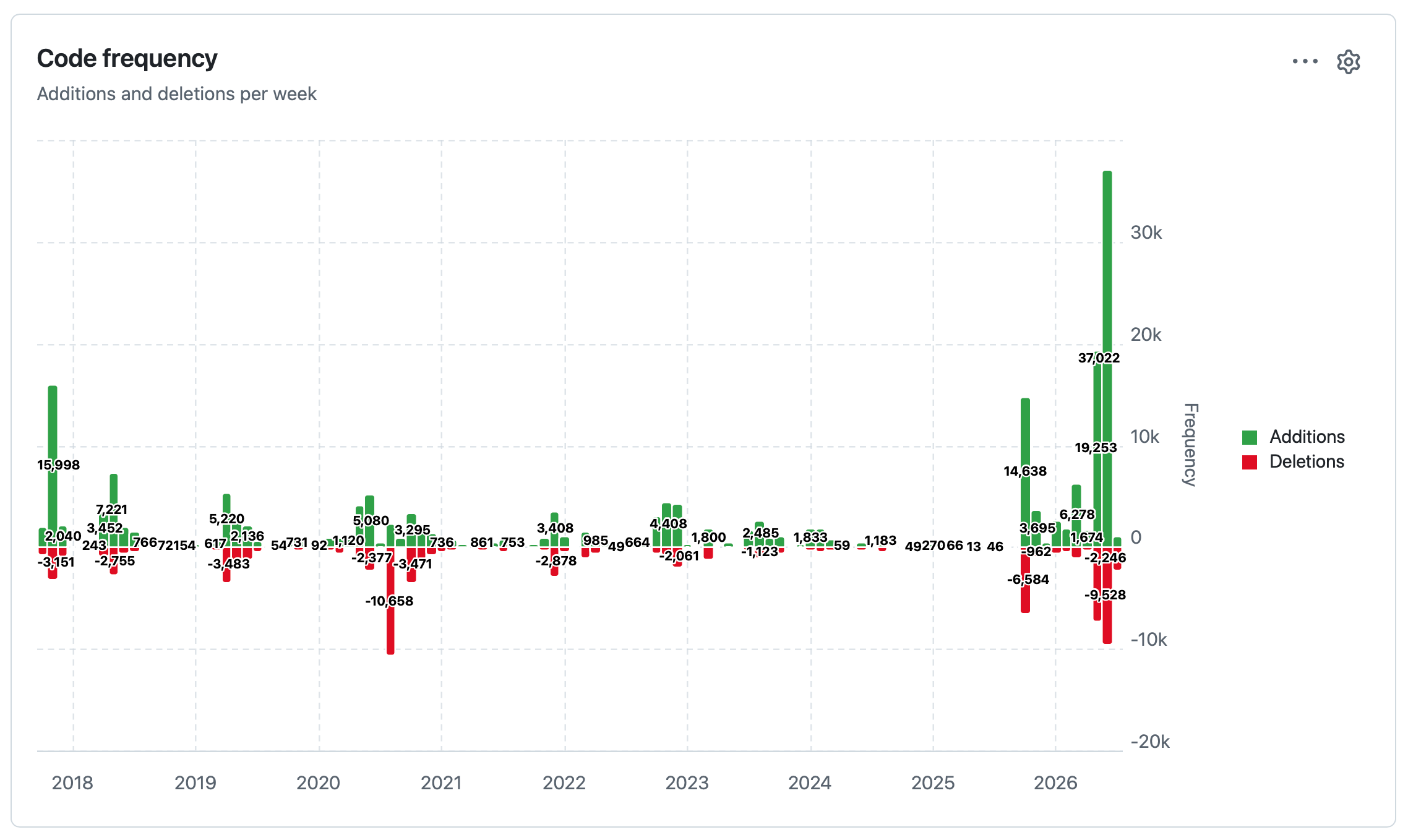
The big spike in activity at the end aligns with Opus 4.8, GPT-5.5, Fable 5 and GPT-5.6 Sol.
Tags: github, ai, datasette, generative-ai, llms, ai-assisted-programming, coding-agents

Martin Alderson
• Martin Alderson
Winners and losers in the coming AI margin collapse (part 2)
Part two: as AI inference margins collapse, who actually captures the value? The hardware supply chain and consumers win, model inference commoditises, and the frontier labs' escape routes are managed agents and staying ahead.

micahflee
• Micah Lee
Mandatory Update: A Short Story

Guess what? Lately I've been nerding out on creative writing. I even joined a local fiction writers group where we meet up at coffee shops. Like, in person!
Anyway, I submitted a short story to the DEF CON 34 Creative Writing Short Story Contest. My story is called
Krebs on Security
• BrianKrebs
Lessons Learned from CISA’s Recent GitHub Leak
The Cybersecurity and Infrastructure Security Agency (CISA) has issued a postmortem on a data leak in which a contractor published dozens of internal CISA credentials -- including AWS Govcloud keys -- in a public GitHub repository for almost six months before being notified by KrebsOnSecurity. Experts say the gaps identified in the agency's initial response provide important lessons that all security teams should absorb.
Prefer STRICT tables in SQLite
In short: I prefer strict tables in SQLite because they avoid some datatype problems, such as putting text in number columns.
SQLite has a feature that I think is underrated: strict tables. Strict tables help enforce rigid typing, preventing mistakes like putting text into i...