
The standard answer to managing dotfiles on NixOS is home-manager. I've never used it, due to two aesthetic and one practical objection:

matklad
• Alex Kladov
davewiner's subscription list, hackerNewsStars category. List created by feedlandDatabase v0.8.16.
matklad
• Alex Kladov
The standard answer to managing dotfiles on NixOS is home-manager. I've never used it, due to two aesthetic and one practical objection:
We’re working on an adventure game, Leonardo’s Moon Ship. The player character, Leo, has the usual pile of animations: idle left and right, walk in four directions, a couple of stair anims. Since implementing the basics of the character, Leo has had this slightly cursed behaviour where he’d grow about 3% taller the moment he started walking, then shrink back when he stopped. His feet would also lift off the ground by up to 27 pixels depending on which way he was facing. Not enough to be obviously broken in a screenshot. Exactly enough to make the game feel wrong.
We have the ability to use compute resources to support our proprietary AI applications (such as Grok 5, which is currently being trained at COLOSSUS II), while also providing access to select compute capacity to third-party customers. For example, in May 2026, we entered into Cloud Services Agreements with Anthropic PBC (“Anthropic”), an AI research and development public benefit corporation, with respect to access to compute capacity across COLOSSUS and COLOSSUS II. Pursuant to these agreements, the customer has agreed to pay us $1.25 billion per month through May 2029, with capacity ramping in May and June 2026 at a reduced fee. The agreements may be terminated by either party upon 90 days’ notice.
— SpaceX S-1, highlights mine
Tags: anthropic, grok, generative-ai, ai, llms

micahflee
• Micah Lee
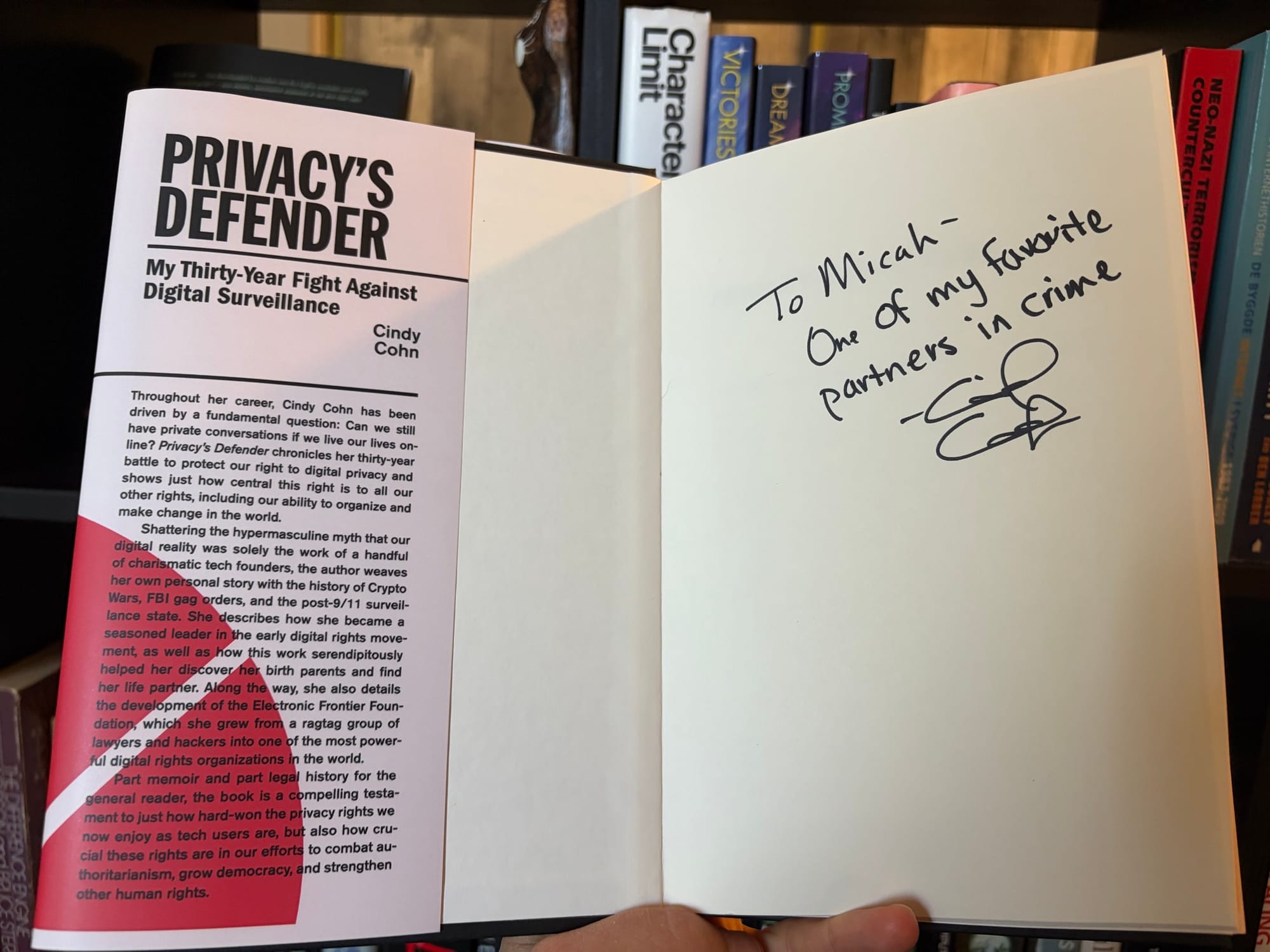
I just finished reading Privacy's Defender: My Thirty-Year Fight Against Digital Surveillance, by my friend Cindy Cohn. It's excellent and you should buy a copy.
Cindy is the Executive Director of the Electronic Frontier Foundation, and this memoir/legal history goes over three major legal

Entropic Thoughts
• kqr
People assume all sorts of wild stock market returns when they make their financial calculations. Here are some numbers that show up on web searches:
| 6 % | 8.4 % | 10 % | 10.1 % | 11.3 % | 11.5 % | 13.6 % | 16 % |
These are all correctly computed under their respective assumptions, but they are very misleading because whatever those assumptions were, they’re not relevant for most calculations. You should assume 4 % in your calculations. Here’s one way to arrive at that:
How fast is 10 tokens per second really?
Neat little HTML app by Mike Veerman (source code here) which simulates LLM token output speeds from 5/second to 800/second.Useful if you see a model advertised as "30 tokens/second" and want to get a feel for what that actually looks like.
Via Hacker News
Tags: ai, generative-ai, llms
I thought about posting this paper but rebranding it as the Claude Mythos technical report. As far as I can tell, there’s no secret tricks the US frontier labs have, and that basically describes how Mythos was trained. What’s in that paper just works, and for verifiable domains, it’s only a matter of fixing bugs and scaling up. That’s why Anthropic is so desperate for regulatory capture, AI has no moat.
Release: llm-gemini 0.32
- New model
gemini-3.5-flashfor Gemini 3.5 Flash.
See also my notes on Gemini 3.5 Flash, and the pelican I drew using this upgrade to the plugin.
Release: datasette-llm-accountant 0.1a4
- Fixed bug tracking chains of responses. Refs datasette-llm#7
Release: llm-gemini 0.32a0
- Compatible with
llm>=0.32a0alpha - adds the ability to stream reasoning tokens.
Release: datasette-llm 0.1a8
- Fix for bug where
llm_prompt_context()hook did not fully collect chains of responses. #7
Jeff Geerling
• Jeff Geerling
At NAB, I found a demo of Wi-Wi STAMP, a wireless time synchronization protocol that came out of Japan's NICT.

Wi-Wi stands for Wireless 2Way interferometry, and it uses the 900 MHz band for picosecond-level time sync, and mm-level distance accuracy, in a tiny box, currently the size of a smartphone.
The system is still in development, but existing prototypes have 20ps of phase synchronization jitter, and time synchronization down to 30ns. The next generation will have time down to 5ns in real-world use.
Andrew Nesbitt
• Andrew Nesbitt
How your dependencies became Bernies

Pluralistic: Daily links from Cory Doctorow
• Cory Doctorow