
Sign up

davewiner's subscription list, hackerNewsStars category. List created by feedlandDatabase v0.8.16.

An external list from lists.opml.org.
https://lists.opml.org/hackerNewsStars.xml

Simon Willison's Weblog Supports Webmention

Syntaqlite Playground

Tool: Syntaqlite Playground

Lalit Maganti's syntaqlite is currently being discussed on Hacker News thanks to Eight years of wanting, three months of building with AI, a deep dive into exactly how it was built.

This inspired me to revisit a research project I ran when Lalit first released it a couple of weeks ago, where I tried it out and then compiled it to a WebAssembly wheel so it could run in Pyodide in a browser (the library itself uses C and Rust).

This new playground loads up the Python library and provides a UI for trying out its different features: formating, parsing into an AST, validating, and tokenizing SQLite SQL queries.
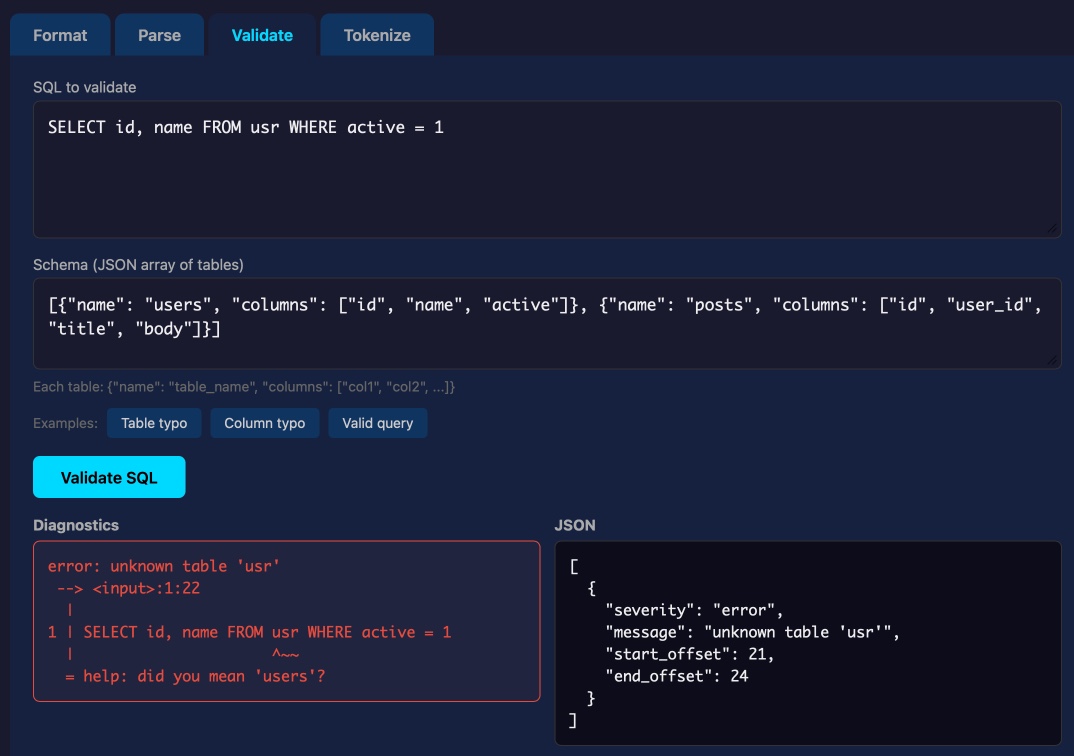
Screenshot of a dark-themed SQL validation playground called SyntaqLite. The "Validate" tab is selected from options including Format, Parse, Validate, and Tokenize. The SQL input contains "SELECT id, name FROM usr WHERE active = 1" with a schema defining "users" and "posts" tables. Example buttons for "Table typo", "Column typo", and "Valid query" are shown above a red "Validate SQL" button. The Diagnostics panel shows an error for unknown table 'usr' with the suggestion "did you mean 'users'?", and the JSON panel displays the corresponding error object with severity, message, and offset fields.

Tags: sql, ai-assisted-programming, sqlite, tools, agentic-engineering

Jim Nielsen’s Blog Valid

I Tried Vibing an RSS Reader and My Dreams Did Not Come True

Simon Willison wrote about how he vibe coded his dream presentation app for macOS. I also took a stab at vibe coding my dream app: an RSS reader. To clarify: Reeder is my dream RSS app and it already exists, so I guess you could say my dreams have already come true? But I’ve...

Michael Stapelbergs Website

Stamp It! All Programs Must Report Their Version

Recently, during a production incident response, I guessed the root cause of an outage correctly within less than an hour (cool!) and submitted a fix just to rule it out, only to then spend many hours fumbling in the dark because we lacked visibility into version numbers and...

Simon Willison's Weblog Supports Webmention

scan-for-secrets 0.2

Release: scan-for-secrets 0.2

  • CLI tool now streams results as they are found rather than waiting until the end, which is better for large directories.
  • -d/--directory option can now be used multiple times to scan multiple directories.
  • New -f/--file option for specifying one or more individual files to scan.
  • New scan_directory_iter(), scan_file() and scan_file_iter() Python API functions.
  • New -v/--verbose option which shows each directory that is being scanned.

Simon Willison's Weblog Supports Webmention

scan-for-secrets 0.1.1

Release: scan-for-secrets 0.1.1

  • Added documentation of the escaping schemes that are also scanned.
  • Removed unnecessary repr escaping scheme, which was already covered by json.

Simon Willison's Weblog Supports Webmention

scan-for-secrets 0.1

Release: scan-for-secrets 0.1 I like publishing transcripts of local Claude Code sessions using my claude-code-transcripts tool but I'm often paranoid that one of my API keys or similar secrets might inadvertently be revealed in the detailed log files. I built this new P...

Simon Willison's Weblog Supports Webmention

research-llm-apis 2026-04-04

Release: research-llm-apis 2026-04-04

I'm working on a major change to my LLM Python library and CLI tool. LLM provides an abstraction layer over hundreds of different LLMs from dozens of different vendors thanks to its plugin system, and some of those vendors have grown new features over the past year which LLM's abstraction layer can't handle, such as server-side tool execution.

To help design that new abstraction layer I had Claude Code read through the Python client libraries for Anthropic, OpenAI, Gemini and Mistral and use those to help craft curl commands to access the raw JSON for both streaming and non-streaming modes across a range of different scenarios. Both the scripts and the captured outputs now live in this new repo.

Tags: llm, apis, json, llms

Dr Paris Buttfield-Addison

Space News, April 2026

These are my notes and expanded thoughts from this month’s Space News segment on ABC Radio Hobart and ABC Northern Tasmania. Every month I join Lucie Cutting on Sunday mornings to chat about what’s happening above and beyond.

Here’s what we discussed, plus some of my notes, and expanded thoughts from this edition of the programme:

Artemis II: Four Humans At The Moon Right Now

Artemis II launched on 1 April. As I write this on Sunday morning, four astronauts are about 169,000 miles from Earth and closing on the Moon. They go behind it tomorrow. This is the first time humans have left low Earth orbit since Apollo 17 in December 1972, fifty-four years ago.

Pluralistic: Daily links from Cory Doctorow
• Cory Doctorow

Pluralistic: EU ready to cave to Trump on tech (04 Apr 2026)

Today's links EU ready to cave to Trump on tech: Surrendermonkeys ahoy. Hey look at this: Delights to delectate. Object permanence: "Among a Thousand Fireflies"; "fiscal" not "physical"; Ontario's pusher premiere can't distribute vaccines; You need your head examined (if you ...

Simon Willison's Weblog Supports Webmention

Quoting Kyle Daigle

[GitHub] platform activity is surging. There were 1 billion commits in 2025. Now, it's 275 million per week, on pace for 14 billion this year if growth remains linear (spoiler: it won't.)

GitHub Actions has grown from 500M minutes/week in 2023 to 1B minutes/week in 2025, and now 2.1B minutes so far this week.

Kyle Daigle, COO, GitHub

Tags: github, github-actions

Simon Willison's Weblog Supports Webmention

Vulnerability Research Is Cooked

Vulnerability Research Is Cooked Thomas Ptacek's take on the sudden and enormous impact the latest frontier models are having on the field of vulnerability research. Within the next few months, coding agents will drastically alter both the practice and the economics of expl...

Simon Willison's Weblog Supports Webmention

The cognitive impact of coding agents

A fun thing about recording a podcast with a professional like Lenny Rachitsky is that his team know how to slice the resulting video up into TikTok-sized short form vertical videos. Here's one he shared on Twitter today which ended up attracting over 1.1m views!

That was 48 seconds. Our full conversation lasted 1 hour 40 minutes.

Tags: ai-ethics, coding-agents, agentic-engineering, generative-ai, podcast-appearances, ai, llms, cognitive-debt

Max Bernstein's Blog

Value numbering

Welcome back to compiler land. Today we’re going to talk about value numbering, which is like SSA, but more. Static single assignment (SSA) gives names to values: every expression has a name, and each name corresponds to exactly one expression. It transforms programs like t...

Simon Willison's Weblog Supports Webmention

Quoting Willy Tarreau

On the kernel security list we've seen a huge bump of reports. We were between 2 and 3 per week maybe two years ago, then reached probably 10 a week over the last year with the only difference being only AI slop, and now since the beginning of the year we're around 5-10 per day depending on the days (fridays and tuesdays seem the worst). Now most of these reports are correct, to the point that we had to bring in more maintainers to help us.

And we're now seeing on a daily basis something that never happened before: duplicate reports, or the same bug found by two different people using (possibly slightly) different tools.

Willy Tarreau, Lead Software Developer. HAPROXY

Tags: security, linux, generative-ai, ai, llms, ai-security-research

Simon Willison's Weblog Supports Webmention

Quoting Daniel Stenberg

The challenge with AI in open source security has transitioned from an AI slop tsunami into more of a ... plain security report tsunami. Less slop but lots of reports. Many of them really good.

I'm spending hours per day on this now. It's intense.

Daniel Stenberg, lead developer of cURL

Tags: daniel-stenberg, security, curl, generative-ai, ai, llms, ai-security-research

Simon Willison's Weblog Supports Webmention

Quoting Greg Kroah-Hartman

Months ago, we were getting what we called 'AI slop,' AI-generated security reports that were obviously wrong or low quality. It was kind of funny. It didn't really worry us.

Something happened a month ago, and the world switched. Now we have real reports. All open source projects have real reports that are made with AI, but they're good, and they're real.

Greg Kroah-Hartman, Linux kernel maintainer (bio), in conversation with Steven J. Vaughan-Nichols

Tags: security, linux, generative-ai, ai, llms, ai-security-research

Simon Willison's Weblog Supports Webmention

Can JavaScript Escape a CSP Meta Tag Inside an Iframe?

Research: Can JavaScript Escape a CSP Meta Tag Inside an Iframe?

In trying to build my own version of Claude Artifacts I got curious about options for applying CSP headers to content in sandboxed iframes without using a separate domain to host the files. Turns out you can inject <meta http-equiv="Content-Security-Policy"...> tags at the top of the iframe content and they'll be obeyed even if subsequent untrusted JavaScript tries to manipulate them.

Tags: iframes, security, javascript, content-security-policy, sandboxing

Simon Willison's Weblog Supports Webmention

The Axios supply chain attack used individually targeted social engineering

The Axios team have published a full postmortem on the supply chain attack which resulted in a malware dependency going out in a release the other day, and it involved a sophisticated social engineering campaign targeting one of their maintainers directly. Here's Jason Saaym...

Jeff Geerling
• Jeff Geerling

Build your own Dial-up ISP with a Raspberry Pi

Last year my aunt let me add her original Tangerine iBook G3 clamshell to my collection of old Macs1.

iBook G3 accessing dial-up Internet over WiFi browsing the vintage web

It came with an AirPort card—a $99 add-on Apple made that ushered in the Wi-Fi era. The iBook G3 was the first consumer laptop with built-in Wi-Fi antennas, and by far the cheapest way to get a computer onto an 802.11 wireless network.

seangoedecke.com RSS feed

Programming (with AI agents) as theory building

Back in 1985, computer scientist Peter Naur wrote “Programming as Theory Building”. According to Naur — and I agree with him — the core output of software engineers is not the program itself, but the theory of how the program works. In other words, the knowledge inside the e...