
davewiner's subscription list, hackerNewsStars category. List created by feedlandDatabase v0.9.3.

Simon Tatham's quasi-blog
• Simon Tatham
Two algorithms for randomly generating aperiodic tilings
A description of the algorithms for generating Penrose and Hat tilings in my puzzle game Loopy.
Reflectie rondetafelgesprek en technische briefing wet cyberoperaties
Gisteren (5 april) was er een technische briefing van de AIVD en MIVD over de tijdelijke wet cyberoperaties, gevolgd door een rondetafelgesprek met deskundigen. Vorige week was er een technische briefing door de toezichthouders TIB en CTIVD. Mijn spreektekst met veel klikbare voetnoten ter verduidelijking staat hier. Er was een goeie opkomst van geïnteresseerden en Kamerleden, en er waren goede en goed geïnformeerde vragen. Verder schreven de media over de bijeenkomsten: De Correspondent, NRC, Trouw, AD, GeenStijl
Growth of AI Through a Cloud Lens
KI: Umwälzung für die Wirtschaft garantiert
Vielen Dank an Lili Laguna für diese Übersetzung diesen niederländischen Blog-Beitrag. English version. Jeder überschlägt sich mit Vorhersagen über KI. Sie wird uns von stupider Arbeit befreien, sie wird unsere Bildung zerstören, wir alle werden nichts mehr lernen müssen, weil die KI es für uns tun wird, Kriminelle werden uns mit ihr austricksen, Gauner werden mit ihr unendliche Mengen an Desinformation erzeugen, und die KI wird entkommen und in der realen Welt gefährlich werden.
AI: Guaranteed to disrupt our economies
This is a machine-aided translation of this Dutch post. Und jetzt auch auf Deutsch verfügbar! Everyone is tumbling over themselves making predictions about AI. It’s going to free us from menial work, it’s going to dismantle our education, we all won’t have to learn things anymore because the AI will do it for us, criminals will trick us with it, crooks will create endless amounts of disinformation with language models, and the AI will escape and become dangerous in the real world.
The Joy of Computer History Books
AI: sowieso ontwrichtend
Update: This article is now also available in English. Und jetzt auch auf Deutsch! Iedereen buitelt over zichzelf heen om voorspellingen te doen over AI. Het gaat ons bevrijden van dom werk, het gaat ons onderwijs ontmantelen, we hoeven allemaal dingen niet meer te leren want de AI gaat het voor ons doen, criminelen zullen ons er mee bedonderen, boeven gaan er eindeloze hoeveelheden desinformatie mee maken, en de AI zal ontsnappen en in de echte wereld gevaarlijk worden.
Hello Deep Learning: Further reading & worthwhile projects
This page is part of the Hello Deep Learning series of blog posts. You are very welcome to improve this page via GitHub! After having completed this series of blogposts (well done!) you should have a good grounding in what deep learning is actually doing. However, this was of course only a small 20k word introduction, so there is a lot left to learn. Unfortunately, there is a lot of nonsense online.
Hello Deep Learning: Doing some actual OCR on handwritten characters
This page is part of the Hello Deep Learning series of blog posts. You are very welcome to improve this page via GitHub! The previous chapters have often mentioned the chasm between “deep learning models that work on my data” and “it actually works in the real world”. It is perhaps for this reason that almost all demos and YouTube tutorials you find online never do any real world testing.
Hello Deep Learning: Dropout, data augmentation, weight decay and quantisation
This page is part of the Hello Deep Learning series of blog posts. You are very welcome to improve this page via GitHub! In the previous chapter we found ways to speed up our character recognition learning by a factor of 20 by using a better optimizer, and a further factor of four by cleverly using threads using a ‘shared nothing architecture’. We also learned how we can observe the development of parameters.
Hello Deep Learning: Hyperparameters, inspection, parallelism, ADAM
This page is part of the Hello Deep Learning series of blog posts. You are very welcome to improve this page via GitHub! In the previous chapter we successfully trained a network to recognize handwritten letters, but it took an awfully long time. This is not just inconvenient: networks that take too long to train mean we can experiment less. Some things really are out of reach if each iteration takes 24 hours, instead of 15 minutes.
Hello Deep Learning: Convolutional networks
This page is part of the Hello Deep Learning series of blog posts. You are very welcome to improve this page via GitHub! In the previous chapter we taught a network of linear combinations and ‘rectified linear units’ to recognize handwritten digits reasonably successfully. But we already noted that the network would be sensitive to the exact location of pixels, and that it does not in any meaningful way “know” what a 7 looks like.
Hello Deep Learning: Reading handwritten digits
This page is part of the Hello Deep Learning series of blog posts. You are very welcome to improve this page via GitHub! In the previous chapter we described how automatic differentiation of the result of neural networks works. In the first and second chapters we designed and trained a one-layer neural network that could distinguish images of the digit 3 and the digit 7, and the network did so very well.
Hello Deep Learning: Automatic differentiation, autograd
This page is part of the Hello Deep Learning series of blog posts. You are very welcome to improve this page via GitHub! In the previous chapter we configured a neural network and made it learn to distinguish between the digits 3 and 7. The learning turned out to consist of “twisting the knobs in the right direction”. Although simplistic, the results were pretty impressive. But, you might still be a bit underwhelmed - the network only distinguished between two digits.
Hello Deep Learning: actually learning something
This page is part of the Hello Deep Learning series of blog posts. You are very welcome to improve this page via GitHub! In this chapter we’re going to take the neural network we made earlier, but actually make it do some learning itself. And, oddly enough, this demonstration will again likely simultaneously make you wonder “is this all??” and also impress you by what even this trivial stuff can do.
Hello Deep Learning: Linear combinations
This page is part of the Hello Deep Learning series of blog posts. You are very welcome to improve this page via GitHub! In this chapter we’re going to build our first neural network and take it for a spin. Weirdly, this demonstration will likely simultaneously make you wonder “is this all??” and also impress you by what even this trivial stuff can do. The first part of this chapter covers the theory, and shows no code.
Hello Deep Learning: Intro
This page is part of the Hello Deep Learning series of blog posts. Also, feel free to skip this intro and head straight for chapter 1 where the machine learning begins! Deep learning and ‘generative AI’ have now truly arrived. If this is a good thing very much remains to be seen. What is certain however is that these technologies will have a huge impact. Up to late 2022, I had unwisely derided the advances of deep learning as overhyped nonsense from people doing fake demos.
Hello Deep Learning
A from scratch GPU-free introduction to modern machine learning. Many tutorials exist already of course, but this one aims to really explain what is going on, from the ground up. Also, we’ll develop the demo until it is actually useful on real life data which you can supply yourself. Other documents start out from the (very impressive) PyTorch environment, or they attempt to math it up from first principles. Trying to understand deep learning via PyTorch is like trying to learn aerodynamics from flying an Airbus A380.

Geoffrey Litt
• Geoffrey Litt
Malleable software in the age of LLMs
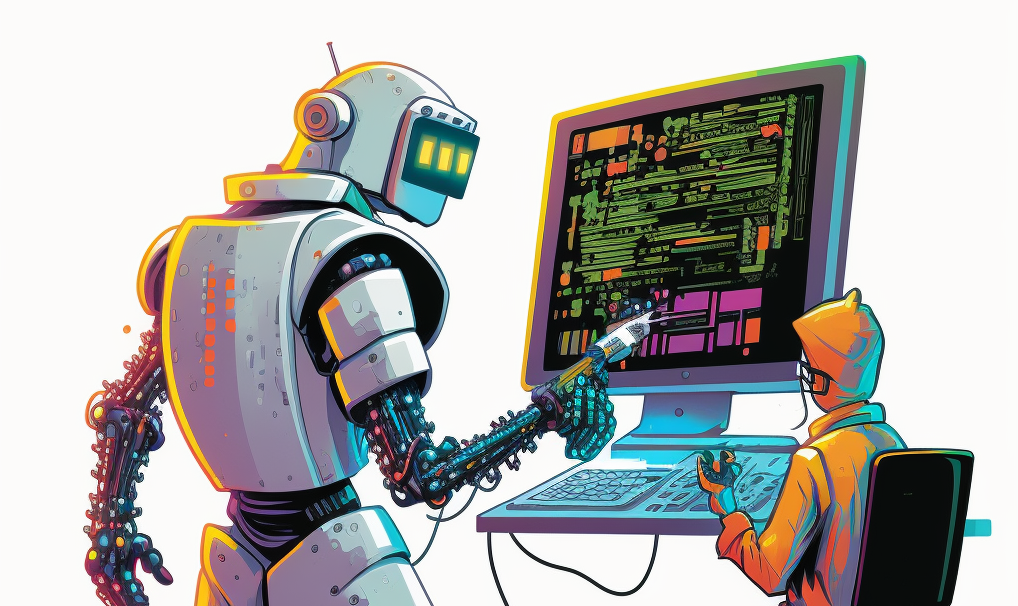
It’s been a wild few weeks for large language models. OpenAI released GPT-4, which shows impressive gains on a variety of capabilities including coding. Microsoft Research released a paper showing how GPT-4 was able to produce quite sophisticated...