In the 1970s, floating-point arithmetic was a mess. Computer manufacturers had a dozen incompatible arithmetic standards.
Moreover, floating-point systems were designed around hardware simplicity rather than mathematical rigor, leading to problems
with numerical stability.
T...
Spacelab was a reusable laboratory that could be carried in the Space Shuttle's cargo bay, providing lab space for astronauts
and experiments.1
Because Spacelab was a European project, it used a French-built minicomputer, the Mitra 125 MS,2
rather than the Shuttle's main com...
In 1948, IBM introduced the 604 Electronic Calculating Punch.
This machine was a programmable calculator, about the size of a double refrigerator.
It was not quite a computer, but was programmed by plugging wires into a plugboard.
This machine read numbers from a punch card,...
The Space Shuttle's five1 general-purpose computers played a critical role in each flight: controlling the
engines, monitoring thousands of sensors, displaying data to the astronauts, and navigating
the Shuttle.
Each computer consisted of two 60-pound aluminum-alloy boxes: t...
In 1980, Intel released the Intel 8087 floating-point coprocessor, a chip that could make math up to 100 times faster.
As well as arithmetic and square roots, the 8087 computed
transcendental functions including tangent, exponentiation, and logarithms.
But it all depended on...
1948 was an interesting time for computing.
For decades, businesses had used punch card equipment that added and sorted electromechanically.
Now these electromechanical relays and counting wheels were being used to build room-filling general-purpose computers such as Harvard...
In 1980, Intel introduced the 8087 floating-point chip, a co-processor that made floating-point operations
up to 100 times faster.
This chip was highly influential, and today most processors use the floating-point standard introduced by the 8087.
The 8087 uses complicated al...
Spacelab was a reusable laboratory that could be carried in the cargo bay of the Space Shuttle, providing lab space for astronauts
and experiments.
Spacelab was controlled by a French-built minicomputer, called the Mitra 125 MS.
Unlike modern computers, this computer didn't ...
Before GPS, how did aircraft navigate?
One important technique was celestial navigation: navigating from the positions of the stars, planets,
or the sun.
While celestial navigation is accurate, cannot be jammed, and doesn't require any broadcast infrastructure,
it is a diffi...
The morning of April 12, 1981, 20 years to the day after Yuri Gagarin became the first person in space, the
Space Shuttle thundered into the Florida sky.
Commander Young and Pilot Crippen were at the controls as the Shuttle ascended on its first flight.
But the launch, like ...
In the 1980s, if you wanted your IBM PC to run faster, you could buy
the Intel 8087 floating-point coprocessor chip.
With this chip, CAD software, spreadsheets, flight simulators, and other programs
were much speedier.
The 8087 chip could add, subtract, multiply, and d...
In 1978, Intel introduced the 8086 processor, a revolutionary chip that led to the modern x86 architecture.
Unlike modern 64-bit processors, however, the 8086 is a 16-bit chip.
Its arithmetic/logic unit (ALU) operates on 16-bit values, performing arithmetic operations such a...
In the 1980s, if you wanted your computer to do floating-point calculations faster, you could buy
the Intel 8087 floating-point coprocessor chip.
Plugging it into your IBM PC would make operations up to 100 times faster, a big boost for spreadsheets
and other number-crunchin...
Early microprocessors were very slow when operating with floating-point numbers.
But in 1980, Intel introduced the 8087 floating-point coprocessor, performing
floating-point operations up
to 100 times faster.
This was a huge benefit for IBM PC
applications such as AutoCAD, s...
I've been studying the standard cell circuitry in the Intel 386 processor recently.
The 386, introduced in 1985, was Intel's most complex processor at the time, containing 285,000 transistors.
Intel's existing design techniques couldn't handle this complexity and the chip be...
The New York Times recently introduced a new daily puzzle called Pips.
You place a set of dominoes on a grid, satisfying various conditions.
For instance, in the puzzle below,
the pips (dots) in the purple squares must sum to 8,
there must be fewer than 5 pips in the re...
The noted Diné (Navajo) weaver Marilou Schultz recently completed an intricate weaving
composed of
thick white lines on a black background, punctuated with reddish-orange diamonds.
Although this striking rug may appear abstract, it shows the internal circuitry of a tiny sili...
I was reading the latest issue of the journal Science, and a paper mentioned the compound Cr2Gr2Te6.
For a moment, I thought my knowledge of the periodic table was slipping, since I couldn't remember the element Gr.
It turns out that Gr was supposed to be Ge, germanium, but ...
I've been reverse-engineering the Intel 386 processor (from 1985), and I've come across some interesting
circuits for the chip's input/output (I/O) pins.
Since these pins communicate with the outside world, they face special dangers:
static electricity and latchup can destro...
Intel released the 386 processor in 1985, the first 32-bit chip in the x86 line.
This chip was packaged in a ceramic square with 132 gold-plated pins protruding from the underside, fitting into
a socket on the motherboard.
While this package may seem boring, a lot more is go...
Have you ever wanted to reverse engineer an analog chip from a die photo?
Wanted to understand what's inside the "black box" of an integrated circuit?
In this article, I explain my reverse engineering process, using the
Philips TDA7000 FM radio receiver chip as an example.
T...
Back in 2021, a collector friend of ours was visiting a dusty warehouse in search of Apollo-era communications equipment.
A box with NASA-style lights caught his eye—the "AGC Confirm" light suggested a connection
with the Apollo Guidance Computer.
Disappointingly, the box wa...
During the Apollo flights to the Moon, the astronauts observed the spacecraft's orientation on a special instrument
called the FDAI (Flight Director / Attitude Indicator).
This instrument showed the spacecraft's attitude—its orientation—by rotating a ball.
This ball was nick...
In 1985, Intel introduced the groundbreaking 386 processor, the first 32-bit processor in the x86 architecture.
To improve performance, the 386 has a 16-byte instruction prefetch queue.
The purpose of the prefetch queue is to fetch instructions from memory before they are ne...
The groundbreaking Intel 386 processor (1985) was the first 32-bit processor in the x86 architecture.
Like most processors, the 386 contains numerous registers; registers are a key part of a processor because
they provide storage that is much faster than main memory.
The reg...
mult3
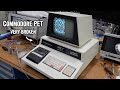
In 1977, Commodore released the PET computer, a quirky home computer that combined the processor,
a tiny keyboard, a cassette drive for storage, and a trapezoidal screen in a metal unit.
The Commodore PET, the Apple II, and Radio Shack's TRS-80 started the home c...
Most people think of machine instructions as the fundamental steps that a computer performs.
However, many processors have another layer of software underneath: microcode.
With microcode, instead of building the processor's control circuitry from complex logic gates, the con...
In the early 1960s, Douglas Engelbart started investigating how computers could augment human intelligence:
"If, in your office, you as an intellectual worker
were supplied with a computer display backed up by a computer that was alive for you all day and was instantly resp...