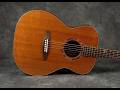
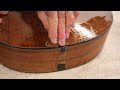
Claro Walnut/Redwood OM - New Home Required!
Guitar Building Tips, Tricks and Works in Progress
In keeping with the theme of this project, which is to make use of nondescript pieces of wood cluttering up the workshop, the bridge I'll fit to this instrument will be fabricated from a highly figured and seriously dense chunk of red gum (Eucalyptus camaldulensis) that I wrenched out of our firewood delivery man's hands a few years ago. "I'm not burning that", I told him!
With a lower bout width of 14.5", a 12th fret body join, and a 24.9" scale length, what else could I call this new model but a "00"?
With plans for an oil-finished neck, I've been able to install frets much sooner than would otherwise be the case; the headstock face and heel cap will be lacquered as usual.
Cheers
Pete
As keen as I am to string these guitars up and wave them goodbye, I have no choice but to wait several weeks for the lacquer top-coats to cure before I sand and polish them. I know from experience that to give in to my typical impatience is an exercise in futility, so the long wait begins.
Cheers, Pete
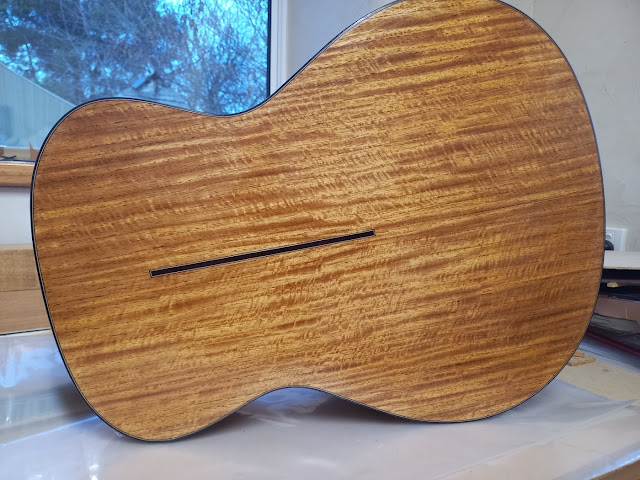
After what feels an eternity, I managed to begin the arduous process of applying finish to this crop of guitars this morning, with a seal coat of shellac applied ahead of the first coats of lacquer tomorrow.
I have three other guitars under construction, but with the inevitability of cold wet weather ahead I vowed to put them to one side and take advantage of our unseasonably dry autumn with a view to finally completing these instruments, some of which I began years ago.
With fresh ideas in mind, I'm well and truly ready to move on from this collection of instruments, and I've come to the realisation that working on a big batch of guitars like this can detract from my enjoyment of the process. A completed instrument would be nice!
Cheers, Pete
With a template describing the bridge outline, and an appropriate jig to facilitate routing of the saddle slot, it's a fairly quick and easy job to fabricate these guitar bridges. A rasp, some cabinet scrapers and sandpaper complete the job after the blank has been cut to shape. The underside of the bridge will be shaped to match the dome of the soundboard at a later stage.
The bridges pictured are of Macassar ebony and padauk. Despite its somewhat extravagant colour, I look forward to using the padauk bridges; it's a much low density than the ebony. Unfortunately, padauk is yet another wood species that has recently been added to the CITES list, so these are the last bridges I'll have the opportunity to make from it.
Cheers, Pete
The back and sides of this guitar are of narra, which is an alternative name for a wood that's most often marketed here in Australia as New Guinea rosewood.
According to Wikipedia, the tree is a species of Pterocarpus native to southeastern Asia, northern Australasia, and the western Pacific Ocean islands, Cambodia, southernmost China, East Timor, Indonesia, Malaysia, Papua New Guinea, the Philippines, the Ryukyu Islands, the Solomon Islands, Thailand, and Vietnam."
The wood is closely related to padauk - it's most definitely not a true rosewood - and as its range extends well beyond New Guinea, I much prefer to choose a less misleading name when discussing this guitar.
Most significantly, it's beautiful, easy to work, smells great and has a good reputation as a tonewood. What's not to like?
Cheers, Pete