Release: sqlite-utils 4.1.1
Mainly a fix for an edge case that regular Claude chat spotted while experimenting with the 4.1 release to answer a question about ON DELETE.
table.transform() now raises a TransactionError if called while a transaction i...
One of the consequences of GPT-5.6 Sol being clearly a Fable/Mythos class model is that Anthropic have, once again, bumped the date that Fable stops being available in their Claude Max plans:
We're extending Claude Fable 5 access on all paid plans, as well as keeping Claude...
Release: sqlite-utils 4.1
The first dot-release since 4.0 a few days ago, introducing a number of minor new features.
sqlite-utils insert and sqlite-utils upsert now accept a --code option for providing a block of Python code (or a path to a .py file) that defines...
The reality is to make augmented reality glasses, you need to put a camera next to your eyes that is continuously recording everything you see and processing that to put information over it.
There is not another way around it. And there's certainly not a chip that can fit i...
[...] Work on web and mobile runs in the cloud. Work in the desktop app can also use local files and desktop apps with your permission. At launch, cloud Work conversations do not appear in desktop Work; desktop Work threads and local files remain on that computer.
— OpenAI, trying (unsuccessfully) to clarify ChatGPT Work
OpenAI's latest flagship model hit general availability this morning, and comes in three sizes: Luna, Terra, and Sol (from smallest to largest).
The new models are priced per 1M input/output tokens as Luna $1/$6, Terra $2.50/$15, Sol $5/$30. For comparison, the Claude Opus s...
Introducing Muse Spark 1.1
Following Muse Spark in April, here's Muse Spark 1.1 - the first Spark model to offer an API. Meta claim significant improvements in agentic tool calling and computer use.
There are a lot more details are in the Muse Spark 1.1 Evaluation Report. Th...
Rewriting Bun in Rust
Jarred Sumner has been promising this blog post (since May 9th) about his Zig to Rust rewrite of Bun for significantly longer than it took him to finish the rewrite.
Honestly, it was worth the wait. This is a detailed description of an extremely sophist...
Introducing GPT‑Live
OpenAI finally upgraded the model used by ChatGPT voice mode!
I've had preview access for a few weeks in the iPhone app, and the new model is very impressive. It also has the ability to spin off harder tasks to GPT-5.5:
For questions that require web se...
I just declared a moratorium against AI-written change descriptions (e.g. PR and commit messages, also issues/tickets) from my team.
AI was writing change descriptions that were worse than useless to me as I tried to review PRs: outlining details of the code that could easily be seen by looking at the code, but omitting the higher-level framing needed to understand broadly what the code is doing.
It takes URLs like that, converts them to https://raw.githubusercontent.com/simonw/sqlite-ast/437c759129154f05296324a7f82aa1246340dd14/sqlite_ast/parser.py, then uses fetch() to fetch them and displays the specified range of lines - with line numbers, no syntax highlighting though
Show me a preview web browser so I can see your work
This morning I released sqlite-utils 4.0, the 124th release of that project and the first major version bump since 3.0 in November 2020. In addition to some small but significant breaking changes (described in this upgrade guide), this version introduces three major features...
tencent/Hy3
New Apache 2.0 licensed model from Tencent in China:
Hy3 is a 295B-parameter Mixture-of-Experts (MoE) model with 21B active parameters and 3.8B MTP layer parameters, developed by the Tencent Hy Team. Following the Hy3 Preview launch in late April, we gathered fe...
I hoped to release sqlite-utils 4.0 stable this weekend, but as I worked through the backlog of issues and PRs with a combination of Claude Fable 5 and GPT-5.5 the changelog since rc2 kept getting bigger.
The biggest new feature is support for introspecting and creating compound foreign keys - a feature that involves a subtle breaking change to table.foreign_keys and hence needed to land for the 4.0 stable release.
sqlite-utils also now follows SQLite's convention for case insensitive column names, which turned out to touch a bunch of different places at once.
I wrote about the sqlite-utils 4.0rc1 release a couple of weeks ago. Since we only have Claude Fable on our Max subscriptions for a few more days, I decided to see if it could help me get to a 4.0 stable release that I felt truly comfortable about, since I try to keep to Sem...
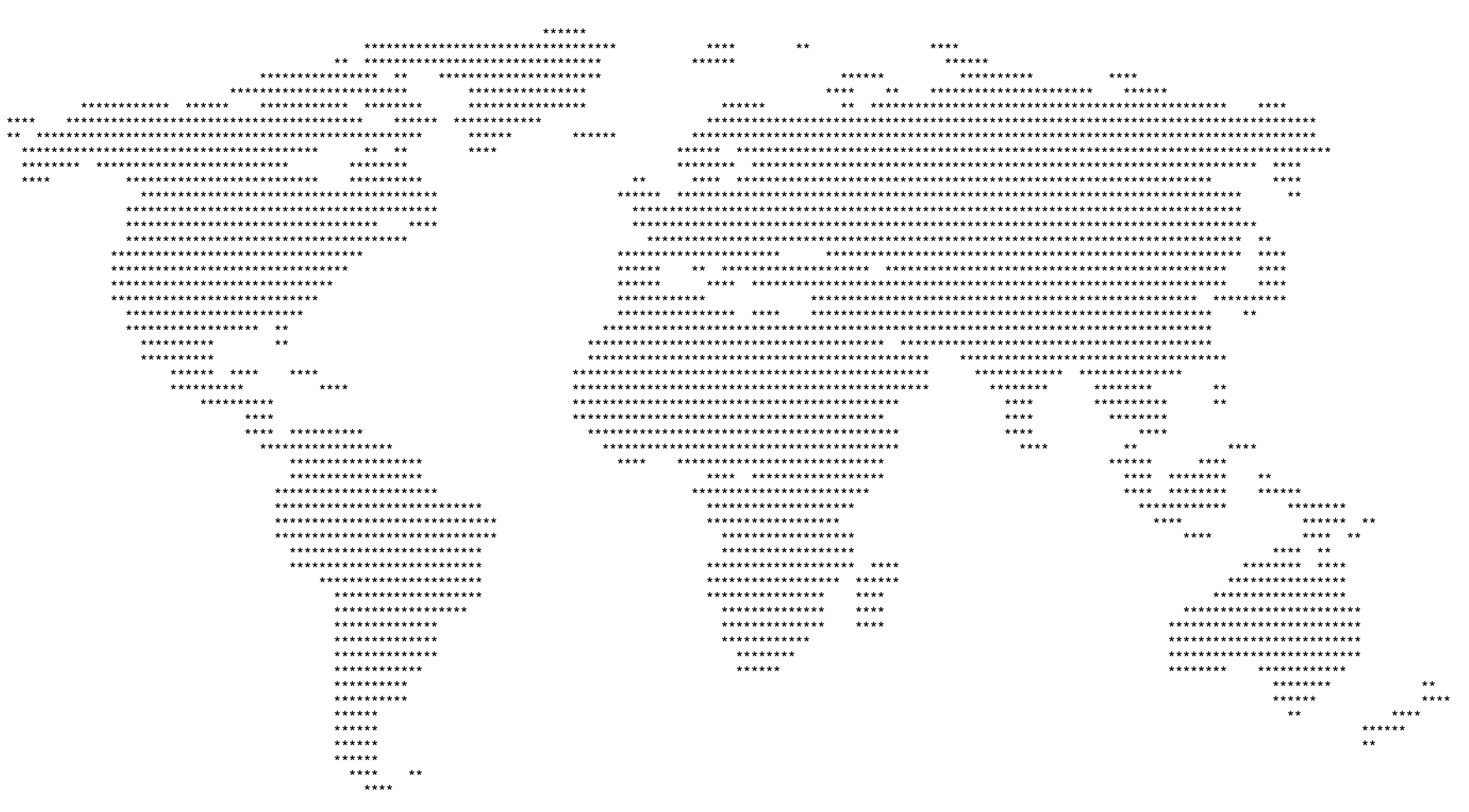
Iwo Kadziela (assisted by Codex) figured out a way to generate a credible ASCII world map using 445 bytes of data:
The key trick is to use deflate compression, which is then wired together using this neat snippet of JavaScript. I didn't know you could use fetch() with data: URIs like this:
fetch('data:;base64,1ZpLsgIxCEXnrM...==').then(
  r => r.body.pipeThrough(new DecompressionStream('deflate-raw'))
).then(
  s => new Response(s).text()
).then(
  t => b.innerHTML = '<pre style=font-size:.65vw>' + t
)
Better Models: Worse Tools
Armin reports on a weird problem he ran into while hacking on Pi:
The short version is that newer Claude models sometimes call Pi’s edit tool with extra, invented fields in the nested edits[] array. And not Haiku or some small model: Opus 4.8. The...
Open Source AI Gap Map
Current AI is "a global partnership building a public option for AI", founded as a non-profit at the AI Action Summit in Paris in February 2025 and backed by serious capital ($400m already committed).
They launched their Gap Map a couple of days ago - ...
I just launched my third course, Whimsical Animations, and so far, it’s on track to sell roughly ⅓ as many copies as a typical course launch.
It’s a similar story with my two existing courses. Sales are down significantly from last year.
There are likely a lot of reasons fo...
One of the most interesting tips I got from the Fireside Chat I hosted with Cat Wu and Thariq Shihipar from the Claude Code team at AIE on Wednesday was to let Fable (and to a certain extent Opus) use their own judgement rather than dictating how they should work.
The exampl...
Release: llm-coding-agent 0.1a0
Another Fable 5 experiment. Now that my LLM library has evolved into more of an agent framework it's time to see what a simple coding agent would look like built on it.
I started a new Python library using my python-lib-template-reposi...
Research: Using DSPy to evaluate and improve Datasette Agent's SQL system prompts
One of this morning's AIE keynotes covered dspy, which reminded me I've been meaning to see if it could help me improve the system prompt used by Datasette Agent - so I fired off an asy...
I saw Geoffrey Litt speak at AIE yesterday, and one framing he used particularly resonated with me:
Understand to participate
Geoffrey was talking about the challenge of collaborating with coding agents as they construct increasingly large and sophisticated changes, and the ...

 Featured