This piece by Bruce Schneier and Nathan E. Sanders is the most thoughtful and grounded coverage I've seen of the recent and ongoing Pentagon/OpenAI/Anthropic contract situation.
AI models are increasingly commodified. The top-tier offerings have about the same performance, and there is little to differentiate one from the other. The latest models from Anthropic, OpenAI and Google, in particular, tend to leapfrog each other with minor hops forward in quality every few months. [...]
In this sort of market, branding matters a lot. Anthropic and its CEO, Dario Amodei, are positioning themselves as the moral and trustworthy AI provider. That has market value for both consumers and enterprise clients.
Agentic Engineering Patterns >
The defining characteristic of a coding agent is that it can execute the code that it writes. This is what makes coding agents so much more useful than LLMs that simply spit out code without any way to verify it.
Never assume that code g...
Clinejection — Compromising Cline's Production Releases just by Prompting an Issue Triager
Adnan Khan describes a devious attack chain against the Cline GitHub repository, which started with a prompt injection attack in the title of an issue opened against the repo.
Cline we...
Introducing GPT‑5.4
Two new API models: gpt-5.4 and gpt-5.4-pro, also available in ChatGPT and Codex CLI. August 31st 2025 knowledge cutoff, 1 million token context window. Priced slightly higher than the GPT-5.2 family with a bump in price for both models if you go above 27...
Over the past few months it's become clear that coding agents are extraordinarily good at building a weird version of a "clean room" implementation of code.
The most famous version of this pattern is when Compaq created a clean-room clone of the IBM BIOS back in 1982. They h...
Agentic Engineering Patterns >
There are some behaviors that are anti-patterns in our weird new world of agentic engineering.
Inflicting unreviewed code on collaborators
This anti-pattern is common and deeply frustrating.
Don't file pull requests with code you haven't...
I'm behind on writing about Qwen 3.5, a truly remarkable family of open weight models released by Alibaba's Qwen team over the past few weeks. I'm hoping that the 3.5 family doesn't turn out to be Qwen's swan song, seeing as that team has had some very high profile departure...
Shock! Shock! I learned yesterday that an open problem I'd been working on for several weeks had just been solved by Claude Opus 4.6 - Anthropic's hybrid reasoning model that had been released three weeks earlier! It seems that I'll have to revise my opinions about "generative AI" one of these days. What a joy it is to learn not only that my conjecture has a nice solution but also to celebrate this dramatic advance in automatic deduction and creative problem solving.
Gemini 3.1 Flash-Lite
Google's latest model is an update to their inexpensive Flash-Lite family. At $0.25/million tokens of input and $1.5/million output this is 1/8th the price of Gemini 3.1 Pro.
It supports four different thinking levels, so I had it output four different pelicans:
minimal
low
medium
high
Tags: google, ai, generative-ai, llms, llm, gemini, llm-pricing, pelican-riding-a-bicycle, llm-release
Agentic Engineering Patterns >
I like to include animated GIF demos in my online writing, often recorded using LICEcap. There's an example in the Interactive explanations chapter.
These GIFs can be pretty big. I've tried a few tools for optimizing GIF file size and my...
I use Claude as a proofreader for spelling and grammar via this prompt which also asks it to "Spot any logical errors or factual mistakes". I'm delighted to report that Claude Opus 4.6 called me out on this one:
Because I write about LLMs (and maybe because of my em dash text replacement code) a lot of people assume that the writing on my blog is partially or fully created by those LLMs.
My current policy on this is that if text expresses opinions or has "I" pronouns attached to it then it's written by me. I don't let LLMs speak for me in this way.
I'll let an LLM update code documentation or even write a README for my project but I'll edit that to ensure it doesn't express opinions or say things like "This is designed to help make code easier to maintain" - because that's an expression of a rationale that the LLM just made up.
I'm moving to another service and need to export my data. List every memory you have stored about me, as well as any context you've learned about me from past conversations. Output everything in a single code block so I can easily copy it. Format each entry as: [date saved, ...
Agentic Engineering Patterns >
When we lose track of how code written by our agents works we take on cognitive debt.
For a lot of things this doesn't matter: if the code fetches some data from a database and outputs it as JSON the implementation details are likely sim...
Because users lose their passkeys all the time, and may not understand that their data has been irreversibly encrypted using them and can no longer be recovered.
Tim Cappalli:
To the wider identity industry: please stop promoting and using passkeys to encrypt user data. I’m begging you. Let them be great, phishing-resistant authentication credentials.
An AI agent coding skeptic tries AI agent coding, in excessive detail
Another in the genre of "OK, coding agents got good in November" posts, this one is by Max Woolf and is very much worth your time. He describes a sequence of coding agent projects, each more ambitious than...
Anthropic are now offering their $200/month Claude Max 20x plan for free to open source maintainers... for six months... and you have to meet the following criteria:
Maintainers: You're a primary maintainer or core team member of a public repo with 5,000+ GitHub stars or 1M+ monthly NPM downloads. You've made commits, releases, or PR reviews within the last 3 months.
Don't quite fit the criteria If you maintain something the ecosystem quietly depends on, apply anyway and tell us about it.
Also in the small print: "Applications are reviewed on a rolling basis. We accept up to 10,000 contributors".
Unicode Explorer using binary search over fetch() HTTP range requests
Here's a little prototype I built this morning from my phone as an experiment in HTTP range requests, and a general example of using LLMs to satisfy curiosity.
I've been collecting HTTP range tricks for a ...
Agentic Engineering Patterns >
Many of my tips for working productively with coding agents are extensions of advice I've found useful in my career without them. Here's a great example of that: hoard things you know how to do.
A big part of the skill in building softwa...
It is hard to communicate how much programming has changed due to AI in the last 2 months: not gradually and over time in the "progress as usual" way, but specifically this last December. There are a number of asterisks but imo coding agents basically didn’t work before December and basically work since - the models have significantly higher quality, long-term coherence and tenacity and they can power through large and long tasks, well past enough that it is extremely disruptive to the default programming workflow. [...]
Google API Keys Weren't Secrets. But then Gemini Changed the Rules.
Yikes! It turns out Gemini and Google Maps (and other services) share the same API keys... but Google Maps API keys are designed to be public, since they are embedded directly in web pages. Gemini API keys c...
If people are only using this a couple of times a week at most, and can’t think of anything to do with it on the average day, it hasn’t changed their life. OpenAI itself admits the problem, talking about a ‘capability gap’ between what the models can do and what people do with them, which seems to me like a way to avoid saying that you don’t have clear product-market fit.
Hence, OpenAI’s ad project is partly just about covering the cost of serving the 90% or more of users who don’t pay (and capturing an early lead with advertisers and early learning in how this might work), but more strategically, it’s also about making it possible to give those users the latest and most powerful (i.e. expensive) models, in the hope that this will deepen their engagement.
tldraw issue: Move tests to closed source repo
It's become very apparent over the past few months that a comprehensive test suite is enough to build a completely fresh implementation of any open source library from scratch, potentially in a different language.
This has worry...
Claude Code Remote Control
New Claude Code feature dropped yesterday: you can now run a "remote control" session on your computer and then use the Claude Code for web interfaces (on web, iOS and native desktop app) to send prompts to that session.
It's a little bit janky rig...
I gave a talk this weekend at Social Science FOO Camp in Mountain View. The event was a classic unconference format where anyone could present a talk without needing to propose it in advance. I grabbed a slot for a talk I titled "The State of LLMs, February 2026 edition", su...
It’s also reasonable for people who entered technology in the last couple of decades because it was good job, or because they enjoyed coding to look at this moment with a real feeling of loss. That feeling of loss though can be hard to understand emotionally for people my age who entered tech because we were addicted to feeling of agency it gave us. The web was objectively awful as a technology, and genuinely amazing, and nobody got into it because programming in Perl was somehow aesthetically delightful.
Agentic Engineering Patterns >
Sometimes it's useful to have a coding agent give you a structured walkthrough of a codebase.
Maybe it's existing code you need to get up to speed on, maybe it's your own code that you've forgotten the details of, or maybe you vibe code...
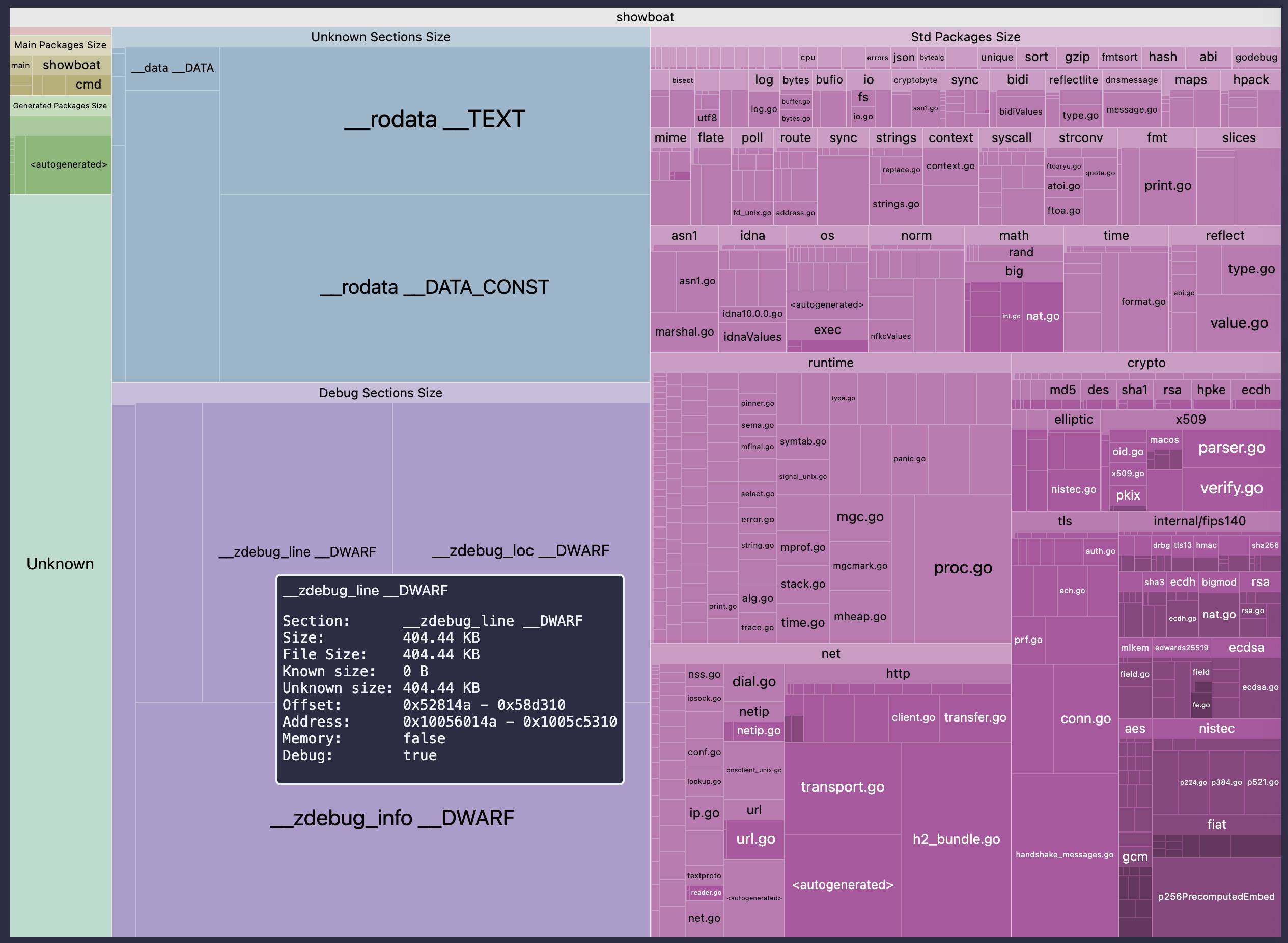
The Go ecosystem is really good at tooling. I just learned about this tool for analyzing the size of Go binaries using a pleasing treemap view of their bundled dependencies.
You can install and run the tool locally, but it's also compiled to WebAssembly and hosted at gsa.zxilly.dev - which means you can open compiled Go binaries and analyze them directly in your browser.
I tried it with a 8.1MB macOS compiled copy of my Go Showboat tool and got this:
Agentic Engineering Patterns >
Automated tests are no longer optional when working with coding agents.
The old excuses for not writing them - that they're time consuming and expensive to constantly rewrite while a codebase is rapidly evolving - no longer hold when an ...
Ladybird adopts Rust, with help from AI
Really interesting case-study from Andreas Kling on advanced, sophisticated use of coding agents for ambitious coding projects with critical code. After a few years hoping Swift's platform support outside of the Apple ecosystem would m...

 Featured