
Tool: SQLite Query Result Formatter Demo
See my notes on SQLite 3.53.0. This playground provides a UI for trying out the various rendering options for SQL result tables from the new Query Result Formatter library, compiled to WebAssembly.
 Featured
Tool: SQLite Query Result Formatter Demo
See my notes on SQLite 3.53.0. This playground provides a UI for trying out the various rendering options for SQL result tables from the new Query Result Formatter library, compiled to WebAssembly.
Lenny posted another snippet from our 1 hour 40 minute podcast recording and it's about kākāpō parrots!
Tags: kakapo
Tool: GitHub Repo Size
GitHub doesn't tell you the repo size in the UI, but it's available in the CORS-friendly API. Paste a repo into this tool to see the size, for example for simonw/datasette (8.1MB).
Release: asgi-gzip 0.3
I ran into trouble deploying a new feature using SSE to a production Datasette instance, and it turned out that instance was using datasette-gzip which uses asgi-gzip which was incorrectly compressing event/text-stream responses.
asgi-gzip was extracted from Starlette, and has a GitHub Actions scheduled workflow to check Starlette for updates that need to be ported to the library... but that action had stopped running and hence had missed Starlette's own fix for this issue.
I ran the workflow and integrated the new fix, and now datasette-gzip and asgi-gzip both correctly handle text/event-stream in SSE responses.
I have a feeling that everyone likes using AI tools to try doing someone else’s profession. They’re much less keen when someone else uses it for their profession.
— Giles Turnbull, AI and the human voice
Research: SQLite WAL Mode Across Docker Containers Sharing a Volume
Inspired by this conversation on Hacker News about whether two SQLite processes in separate Docker containers that share the same volume might run into problems due to WAL shared memory. The answer is that everything works fine - Docker containers on the same host and filesystem share the same shared memory in a way that allows WAL to collaborate as it should.
Release: datasette-ports 0.2
- No longer requires Datasette - running
uvx datasette-portsnow works as well.- Installing it as a Datasette plugin continues to provide the
datasette portscommand.
Tags: datasette
Release: scan-for-secrets 0.3
- New
-r/--redactoption which shows the list of matches, asks for confirmation and then replaces every match withREDACTED, taking escaping rules into account.- New Python function
redact_file(file_path: str | Path, secrets: list[str], replacement: str = "REDACTED") -> int.
Tags: projects
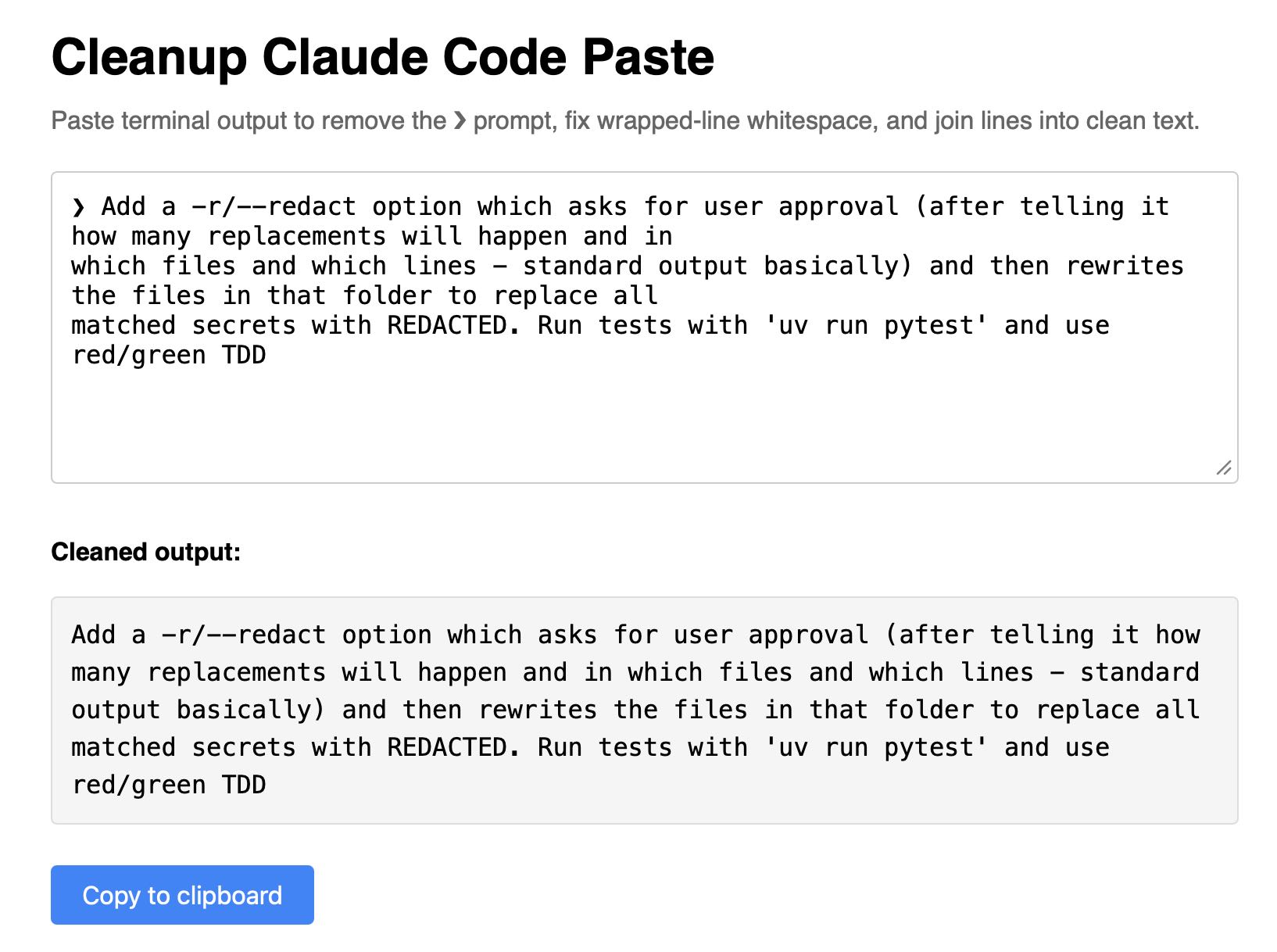
Tool: Cleanup Claude Code Paste
Super-niche tool this. I sometimes copy prompts out of the Claude Code terminal app and they come out with a bunch of weird additional whitespace. This tool cleans that up.
Tags: tools, claude-code
Release: datasette-ports 0.1
Another example of README-driven development, this time solving a problem that might be unique to me.
I often find myself running a bunch of different Datasette instances with different databases and different in-development plugins, spreads across dozens of different terminal windows - enough that I frequently lose them!
Now I can run this:
datasette install datasette-ports
datasette ports
And get a list of every running instance that looks something like this:
http://127.0.0.1:8333/ - v1.0a26
  Databases: data
  Plugins: datasette-enrichments, datasette-enrichments-llm, datasette-llm, datasette-secrets
http://127.0.0.1:8001/ - v1.0a26
  Databases: creatures
  Plugins: datasette-extract, datasette-llm, datasette-secrets
http://127.0.0.1:8900/ - v0.65.2
  Databases: logs
Tags: datasette
From anonymized U.S. ChatGPT data, we are seeing:
- ~2M weekly messages on health insurance
- ~600K weekly messages [classified as healthcare] from people living in “hospital deserts” (30 min drive to nearest hospital)
- 7 out of 10 msgs happen outside clinic hours
— Chengpeng Mou, Head of Business Finance, OpenAI
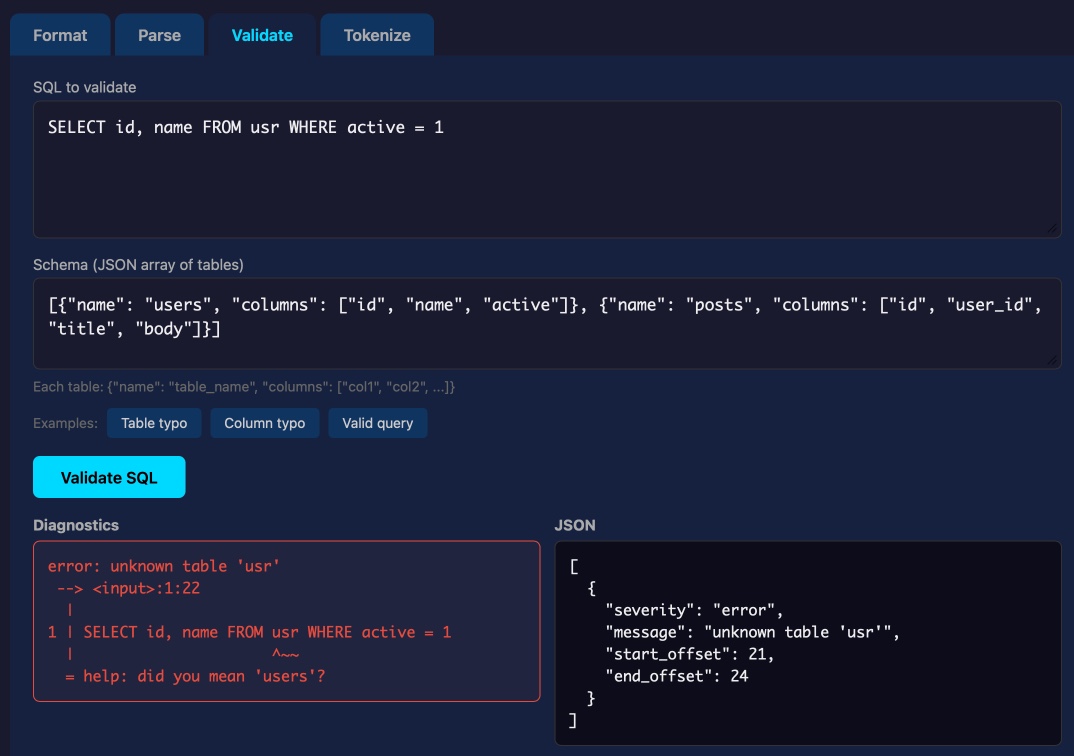
Tool: Syntaqlite Playground
Lalit Maganti's syntaqlite is currently being discussed on Hacker News thanks to Eight years of wanting, three months of building with AI, a deep dive into exactly how it was built.
This inspired me to revisit a research project I ran when Lalit first released it a couple of weeks ago, where I tried it out and then compiled it to a WebAssembly wheel so it could run in Pyodide in a browser (the library itself uses C and Rust).
This new playground loads up the Python library and provides a UI for trying out its different features: formating, parsing into an AST, validating, and tokenizing SQLite SQL queries.
Tags: sql, ai-assisted-programming, sqlite, tools, agentic-engineering
Release: scan-for-secrets 0.2
-d/--directory option can now be used multiple times to scan multiple directories.-f/--file option for specifying one or more individual files to scan.scan_directory_iter(), scan_file() and scan_file_iter() Python API functions.-v/--verbose option which shows each directory that is being scanned.Release: scan-for-secrets 0.1.1
- Added documentation of the escaping schemes that are also scanned.
- Removed unnecessary
represcaping scheme, which was already covered byjson.
Release: research-llm-apis 2026-04-04
I'm working on a major change to my LLM Python library and CLI tool. LLM provides an abstraction layer over hundreds of different LLMs from dozens of different vendors thanks to its plugin system, and some of those vendors have grown new features over the past year which LLM's abstraction layer can't handle, such as server-side tool execution.
To help design that new abstraction layer I had Claude Code read through the Python client libraries for Anthropic, OpenAI, Gemini and Mistral and use those to help craft curl commands to access the raw JSON for both streaming and non-streaming modes across a range of different scenarios. Both the scripts and the captured outputs now live in this new repo.
[GitHub] platform activity is surging. There were 1 billion commits in 2025. Now, it's 275 million per week, on pace for 14 billion this year if growth remains linear (spoiler: it won't.)
GitHub Actions has grown from 500M minutes/week in 2023 to 1B minutes/week in 2025, and now 2.1B minutes so far this week.
— Kyle Daigle, COO, GitHub
Tags: github, github-actions
A fun thing about recording a podcast with a professional like Lenny Rachitsky is that his team know how to slice the resulting video up into TikTok-sized short form vertical videos. Here's one he shared on Twitter today which ended up attracting over 1.1m views!
That was 48 seconds. Our full conversation lasted 1 hour 40 minutes.
Tags: ai-ethics, coding-agents, agentic-engineering, generative-ai, podcast-appearances, ai, llms, cognitive-debt
On the kernel security list we've seen a huge bump of reports. We were between 2 and 3 per week maybe two years ago, then reached probably 10 a week over the last year with the only difference being only AI slop, and now since the beginning of the year we're around 5-10 per day depending on the days (fridays and tuesdays seem the worst). Now most of these reports are correct, to the point that we had to bring in more maintainers to help us.
And we're now seeing on a daily basis something that never happened before: duplicate reports, or the same bug found by two different people using (possibly slightly) different tools.
— Willy Tarreau, Lead Software Developer. HAPROXY
Tags: security, linux, generative-ai, ai, llms, ai-security-research
The challenge with AI in open source security has transitioned from an AI slop tsunami into more of a ... plain security report tsunami. Less slop but lots of reports. Many of them really good.
I'm spending hours per day on this now. It's intense.
— Daniel Stenberg, lead developer of cURL
Tags: daniel-stenberg, security, curl, generative-ai, ai, llms, ai-security-research
Months ago, we were getting what we called 'AI slop,' AI-generated security reports that were obviously wrong or low quality. It was kind of funny. It didn't really worry us.
Something happened a month ago, and the world switched. Now we have real reports. All open source projects have real reports that are made with AI, but they're good, and they're real.
— Greg Kroah-Hartman, Linux kernel maintainer (bio), in conversation with Steven J. Vaughan-Nichols
Tags: security, linux, generative-ai, ai, llms, ai-security-research
Research: Can JavaScript Escape a CSP Meta Tag Inside an Iframe?
In trying to build my own version of Claude Artifacts I got curious about options for applying CSP headers to content in sandboxed iframes without using a separate domain to host the files. Turns out you can inject <meta http-equiv="Content-Security-Policy"...> tags at the top of the iframe content and they'll be obeyed even if subsequent untrusted JavaScript tries to manipulate them.
Tags: iframes, security, javascript, content-security-policy, sandboxing