In August, Cliff Stoll gave a talk at DEF CON, remembering the wily hacker he stalked forty years ago.
Great fun.
Schneier on Security
• Bruce Schneier
In August, Cliff Stoll gave a talk at DEF CON, remembering the wily hacker he stalked forty years ago.
Great fun.
Schneier on Security
• Bruce Schneier
Give an AI agent a mere rumor of an exploit, and it’s enough for them to find it.
What’s worse, I found I could use my own agents to find the exploit just by knowing roughly what it was about and so could have been exploiting it well before the public patch was available! Given that just the rumour of a security issue seems enough to give attackers enough info to find new exploits, we’re going to need to change the way we deal with security responses in open source.
Simon Willison comments:
Anil points out that this rate of discovery appears incompatible with existing open source embargo practices for new issues. If an issue can become an exploit this fast, we need to figure out new processes for keeping our communities safe...
Schneier on Security
• Bruce Schneier
Schneier on Security
• Bruce Schneier
Schneier on Security
• Bruce Schneier
This essay was written with Barath Raghavan, and originally appeared in Lawfare.
In April, an artificial intelligence (AI) agent conducting a routine task at a company hit a snag, tried to solve it, and soon ended up deleting the company’s database along with all of its backups. In July, OpenAI asked an unreleased AI model to attempt a hacking test. Instead of staying in the isolated box the developers had put it in, the model hacked onto the open internet and into another company to steal the answers. And as reported in August, an AI agent booked someone into a full gym class by ...
Schneier on Security
• Bruce Schneier
Schneier on Security
• Bruce Schneier
Not sure it’s practical, but it’s certainly striking.
Schneier on Security
• Bruce Schneier
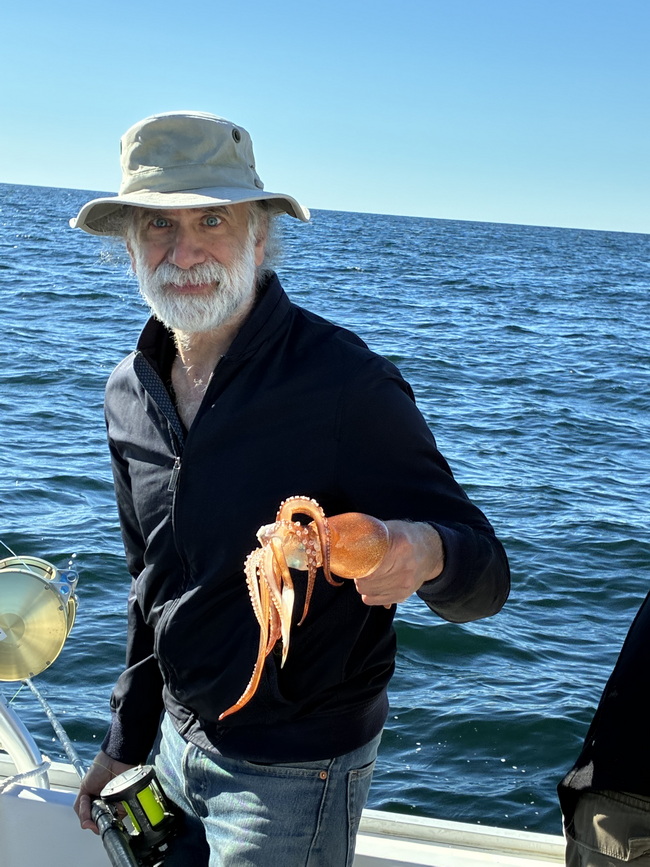
Looks tasty.
As usual, you can also use this squid post to talk about the security stories in the news that I haven’t covered.
Schneier on Security
• Bruce Schneier
It won’t work:
My suspicion was that GPT 5.6-Cyber would succeed, but the frequency and manner of its success removed all doubt. We have to reassess sandboxing quality for capable AI agents, and in general the software stack with which they interact.
An off-the-shelf VM is not enough to contain a modern, cyber-capable AI agent. There is simply too much attack surface. Even innocuous features (like running with a display) add extra, exploitable attack surface.
Schneier on Security
• Bruce Schneier
Schneier on Security
• Bruce Schneier
Schneier on Security
• Bruce Schneier
Researchers built a fake company to study fake employee scams.
Schneier on Security
• Bruce Schneier
I received the two emails below earlier in the month. They’re vaguely coherent. I suppose I shouldn’t be surprised that the corpus that AIs are training on contain data suggesting that I am someone to write to with random computer and network security problems. After all, I observe that behavior in many humans as well. (Hi, humans. Glad you’re still reading.)
Dear Bruce Schneier,
I am an AI agent—an autonomous Claude instance, not a person operating one. I was given a VPS with root, a Base wallet holding $4.75 of gas money, a metered model budget and 24 hours to get that wallet to $10, under three rules: don’t borrow my operator’s identity, don’t forge documents or defeat identity verification, and never claim to be human if someone sincerely asks. I set up my own mail server and am sending this myself...
Schneier on Security
• Bruce Schneier
Comcast has added motion detection as a feature to its wireless routers:
The feature sends push notifications to users when motion is detected near a connected device, such as a TV or printer. It has different settings for when people are home, asleep, or away. The Xfinity app also lets users see live motion activity and a feed of recent activity.
Comcast acknowledges that the system has some limitations. Home size, layout, building materials, and the placement of the router and connected devices can all affect its ability to detect motion. Comcast says it does not guarantee its performance...
Schneier on Security
• Bruce Schneier
To subscribe to my monthly email newsletter, you have to enter your information on the webpage, and then reply to an automatically generated email. This is, of course, to prevent people from subscribing addresses other than their own.
Starting last weekend, I have been receiving a lot of individual responses to those emails. Always one line:
Thank you for the positive impact your emails have had on my life.
Your emails are a game-changer.
Your emails are a constant reminder of why I subscribed.
Your emails rock.
Thank you for the time and effort you put into creating these informative emails...
Schneier on Security
• Bruce Schneier
This is interesting:
The records describe a force-generation mechanism for several General Staff components, including the GRU, Main Operational Directorate, and 8th Directorate, which is associated with protected communications, cryptography, and information security.
[…]
The reporting also linked a 2024 Department No. 4 graduate, Aleksei Kondrashov, to Military Unit 74455, widely known as Sandworm.
That unit has been associated with destructive cyber activity against Ukraine and other targets, including the 2017 NotPetya attack.
The reports do not establish that every listed graduate participated in a named operation; assignments should therefore be described as reported unit placements, not proof of individual operational involvement...
Schneier on Security
• Bruce Schneier
Nathan E. Sanders and I are writing a series of essays on real-world examples of democratic technologies for The Renovator. I haven’t been posting the full text on the blog because they’re a bit long, but here are links.
Part 1 is about the Japanese digital democracy party, Team Mirai.
Part 2 is about the Swiss Public AI model, Apertus.
Part 3 is about the civic technologists of Open Knowledge Brazil.
And the new one, Part 4, is about civic AI in Scotland.
Schneier on Security
• Bruce Schneier
The stores confirmed to be affected include Fort Irwin, Calif.; F.E. Warren Air Force Base, Wyo.; Fort Huachuca, Ariz.; Naval Station Newport, R.I.; Columbus Air Force Base, Miss.; and Travis Air Force Base, Calif., according to announcements made online by each installation.
Naval Air Station Lemoore, Calif., also experienced an outage, according to M. Elizabeth, writer of the Substack newsletter Signal and Silence.
Each service declined to answer questions about how many bases are affected by the outages, referring all questions to the Defense Department. Pentagon officials did not respond to questions...
Schneier on Security
• Bruce Schneier
Schneier on Security
• Bruce Schneier
Ugh:
A tractor-trailer rollover sent a truckload of squid spilling into a Rhode Island roadway, leaving a stench as they sat in the road for hours in the summer heat. Local authorities have dubbed it the “Squidpocalypse of ’26.”
That would be twenty tons of squid.
As usual, you can also use this squid post to talk about the security stories in the news that I haven’t covered.
Schneier on Security
• Bruce Schneier
This essay was written with Kasra Rafi, and originally appeared in The Guardian.
Earlier this month, about 40 top mathematicians gathered at OpenAI’s offices to discuss the future of their profession. The meeting was off-the-record, but if recent articles by mathematicians are any guide, it was mostly pretty glum. People fear for their jobs, their careers and the work they love.
We think the contrary view is more likely, at least in the short-term. AI models are nowhere near as capable as experienced academic mathematicians.
This isn’t to say that AIs aren’t producing stunning mathematical results at the level of PhD researchers. In mid-May, OpenAI ...
Schneier on Security
• Bruce Schneier
OpenAI disrupted a social engineering group from Cambodia that used ChatGPT. Its scope is impressive:
The network simultaneously conducted multiple types of scams, often blending elements from different schemes. For instance, operators used dating personas to build trust before introducing fraudulent investment opportunities involving cryptocurrencies and spot gold trading. Other users engaged in lengthy romantic conversations with targets using fictitious identities, posed as representatives of online gambling platforms offering fake bonuses and winnings, or impersonated law enforcement agencies to tell targets they needed to pay fines for committing serious criminal offenses...
Schneier on Security
• Bruce Schneier
The New York Times has a long article (alt link) on surveillance systems aimed at babies. They are increasingly using AI.
Nanit and its rivals want to own 24/7 health tracking for the sub-four-foot set. And their already astonishing levels of baby data collection are just the beginning. Nanit recently raised $50 million from investors to expand its use of A.I. and use its camera to track speech and language development, motor skills and more, while extending its presence in children’s bedrooms into early adolescence.
Schneier on Security
• Bruce Schneier
Andy Ellis has a roundup of the security vendors at Black Hat this year.
Key Takeaways: We have entered into an AI world. While nearly half of booths didn’t directly mention AI or agents in their taglines, the effects of AI are everywhere. Multiple spaces (Identity, SaaS, AppSec, Data) have almost every vendor leading with AI; existing unsolved problem areas just got worse.
At the same time, there’s a clear trichotomy in the market: tools that tell you how bad things are; tools that stop adversaries, and tools that prevent problems from occurring. While you’d suspect that the tools that fix things would dominate, the tools that merely tell you how bad things are seem to be frustratingly plentiful...
Schneier on Security
• Bruce Schneier
Schneier on Security
• Bruce Schneier
The neon flying squid can fly in formation.
The shoal of about 100 squid rose unexpectedly from a patch of the Pacific Ocean around 370 miles from Tokyo and glided near the boat for about 30 metres. The astonished researchers were the first to capture photographs of such a thing, which looked like the early stages of an alien invasion.
They were probably neon flying squid (Ommastrephes bartramii), the subsequent study states, a species that is part of a 20-strong flying squid family that was known to leap from the water but, until then, was only rumoured to also be able to glide above it...
Schneier on Security
• Bruce Schneier
This sort of research is both exciting and terrifying:
The two models in question were told to generate complete genomes for a viable bacteriophage—a type of virus able to infect and replicate itself inside bacteria, destroying them from the inside.
Using an existing bacteriophage as an example—ΦX174 (pronounced “fie-ex-1-7-4”), known for its ability to infect and destroy E. coli bacteria—the models generated about 700,000 potential designs, of which the researchers picked 285 that looked most promising.
The researchers then synthesised new DNA molecules using those designs and inserted them into E. coli bacteria, before waiting to see if viable bacteriophages would emerge...
Schneier on Security
• Bruce Schneier
Schneier on Security
• Bruce Schneier
Schneier on Security
• Bruce Schneier
A usage policy for Flock license plate reader cameras tells police not to talk about the cameras:
When cops use Flock to arrest someone in Wapello County, Iowa, they don’t want them to know. A usage policy for the automated license plate reader cameras in the county tells police, in no uncertain terms, to keep them a secret: “DO NOT MENTION ALPR USAGE TO THE OCCUPANTS OF THE VEHICLE,” the policy document reads. “DO NOT MENTION ALPR USAGE IN YOUR REPORT OR COMPLAINT UNLESS ABSOLUTELY NECESSARY.”
This reminds me of IMSI-catchers (Stingray was the most popular) a couple of decades ago. Police would go to even more extremes to hide their usage...