


And on Friday there is The Web You Want event at the CMD in Amsterdam. I will be giving a proper talk about how I used CSS to draw a clock on an oscilloscope... No wait, about how I used WebAudio and blew up my oscilloscope. It's a free event, so join us! There may be lasers.
Next week is @smashingconf week. I've never been before and can't wait to be there as an attendee.
On Monday there is the Jam Session, where I will be giving a 10 minute run-through of cssDoom. No slides, just me playing DOOM and showing how I build it.
RE: https://mastodon.social/@btconf/116362469509964678
I am so honoured to be part of #btconf this year. This conference has been such a huge inspiration to me over the years. Been working on this talk for at least a year and expect chaotic energy with lots of weird and wonderful web experiments.

Hot on the heels of iA Notebook winning the 2026 iF Design Gold Award, we took the opportunity to share some behind-the-scenes footage of how iA Notebook is made.
https://ia.net/topics/paper-alchemy-the-making-of-ia-notebook
Smoke machine powered by CSS!
Fully based on web platform tech, such as WebUSB for the DMX connection and CSS for controlling everything.
My projects can sometimes get a little bit out of hand. Want to know more? Come see my talk at @btconf
Sometimes I feel like I have too many projects. I move from one to the other and old projects get ignored because I am working on something new and shiny.
But that chaos also helps me be creative and challenge me to improve my skills. But today I'm feeling like a mad professor. In a good way.
The core is just CSS – which acts as a state machine. Inputs set classes and custom properties. The output is just sampled computed styles from the DOM. Animations are defined in CSS. Buttons are setting classes with values or animations. The laser is tracing SVG elements.
I love the web.
This is one of the projects I've been obsessed with for the last year or so and it brings so much together. From heart rate monitors and Joy-Con gyroscopes to lasers and even flamethrowers.
BTW, the music is Dream Life by Ren & The Skinner Brothers – from my favourite album of last year.
Putting the final touches on audio input for the DMX/Laser controller project. It analyses the audio and sets a class every time it detects a beat. That allows animations to start, or lights to change colour or the laser to draw patterns.
Crazy that all of this is build using web technology.
Great! My clock now randomly thinks it is a VCR. And nobody knows how to set the time on a VCR so it just blinks 12:00.
Also it sometimes it forgets to reset after midnight so it goes from 23:59 to 24:00 to 25:00 and on.
And yes. I am using a round display for a square digital clock…
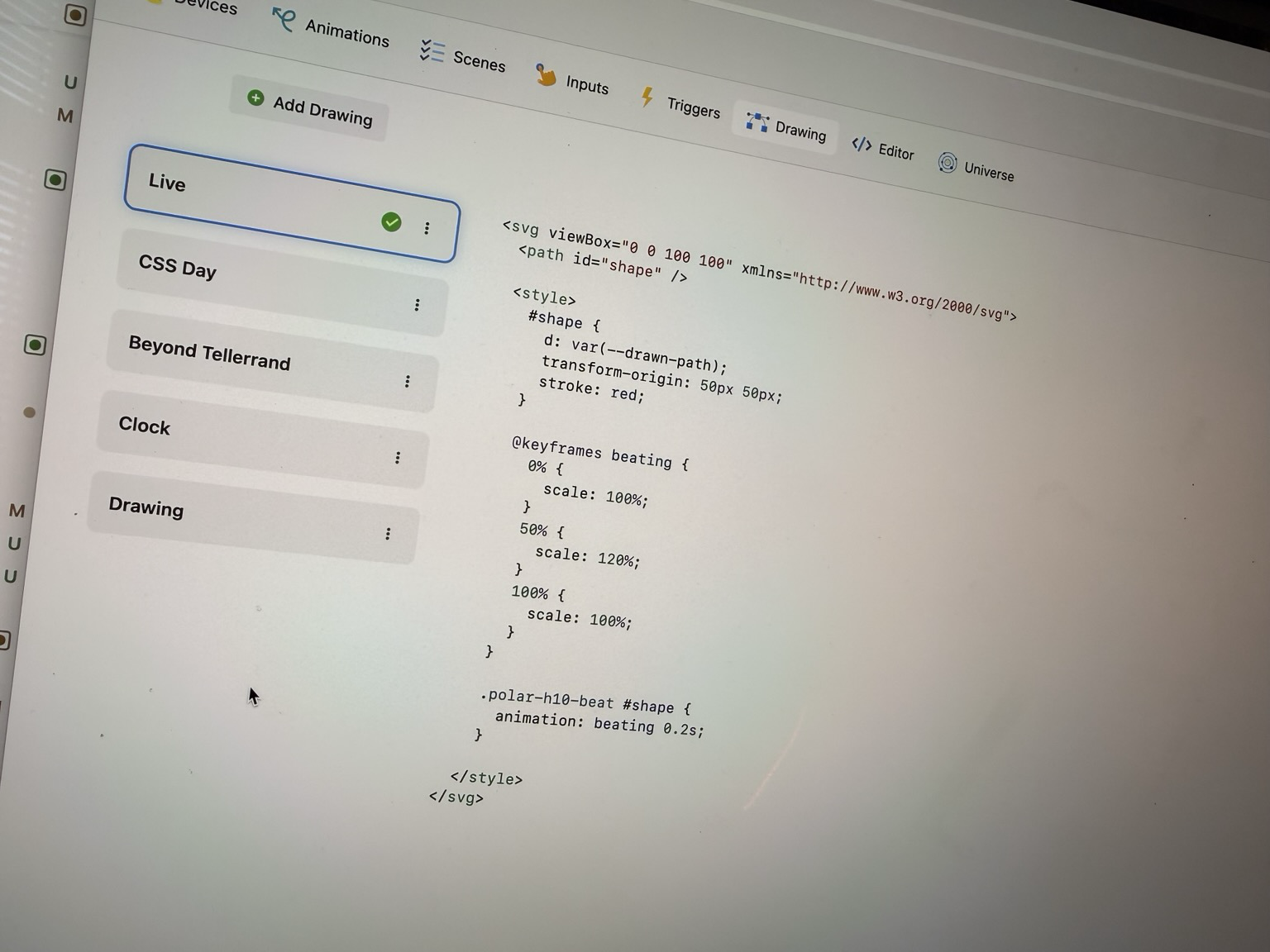
Don’t believe it? This is the actual code that gets rendered, sampled and send to the laser projector.

iA
• iA Inc
Madness and Imagination
We all have plenty of reason to get mad about how messed up things are around us. But only a tiny few are mad enough to do something about it.
Bram.us
• Bramus!
Introducing view-transitions-toolkit, a collection of utility functions to more easily work with View Transitions.
Over the past years, I’ve published a bunch of View Transitions contents: articles, talks, demos, etc. I’ve also done a bunch of more experimental things with them, such as optimizing the keyframes or driving a View Transition by scroll.
What I noticed while doing all those experiments is that I repeated a lot of the code … and they were scattered a bit all over the place as well. So I bundled that all up in a package: view-transitions-toolkit.
Original Content – Bram.us
• Bramus!
Introducing view-transitions-toolkit, a collection of utility functions to more easily work with View Transitions.
Over the past years, I’ve published a bunch of View Transitions contents: articles, talks, demos, etc. I’ve also done a bunch of more experimental things with them, such as optimizing the keyframes or driving a View Transition by scroll.
What I noticed while doing all those experiments is that I repeated a lot of the code … and they were scattered a bit all over the place as well. So I bundled that all up in a package: view-transitions-toolkit.
Over the past years, I’ve written a bunch of posts and done quite a few experiments with View Transitions, such as optimizing the keyframes (so that they animate on the compositor) or driving a VT by scroll.
I noticed I repeated a lot of code while creating all those … so I bundled that all up in a package for you to use as well.
Optimizing the keyframes or a VT for example now is just a one-liner: optimize(transition);
Authorship lets you attribute parts of your text to different authors.
Clearly identify what you wrote and who else helped, including AI sources.
Try Authorship in Writer for Windows by joining the beta: https://ia.net/topics/who-wrote-this
Bram.us
• Bramus!
CSS position: sticky now sticks to the nearest scroller on a per axis basis!
If you’ve ever tried to build a data table with a sticky header and a sticky first column, you know the pain. You’d think a simple position: sticky with top: 0 and left: 0 would be enough, but the reality was that only one of both would stick.
A recent change to CSS fixes this: position: sticky now plays nice with single-axis scrollers, allowing you to have sticky elements that track different scroll containers on different axes. This change is available in Chrome 148.
Original Content – Bram.us
• Bramus!
CSS position: sticky now sticks to the nearest scroller on a per axis basis!
If you’ve ever tried to build a data table with a sticky header and a sticky first column, you know the pain. You’d think a simple position: sticky with top: 0 and left: 0 would be enough, but the reality was that only one of both would stick.
A recent change to CSS fixes this: position: sticky now plays nice with single-axis scrollers, allowing you to have sticky elements that track different scroll containers on different axes. This change is available in Chrome 148.
If you’ve ever tried to build a data table with a sticky header and a sticky first column, you know the pain: the reality was that only one of both would stick.
A recent change to CSS fixes this: `position: sticky` now plays nice with _single-axis scrollers_.

Hello my name is Niels Leenheer
• Niels
CSS is DOOMed
No, CSS is awesome. CSS is better than ever and it is only getting better. And that is why I built DOOM in CSS. Every wall, floor, barrel, and imp is a <div>, positioned in 3D space using CSS transforms. The game logic runs in JavaScript, but the rendering is entirely CSS. You can play […]
The post CSS is DOOMed appeared first on Hello my name is Niels Leenheer.